Three Days Ahead:
‘Enough Is Enough’ Protest Loads
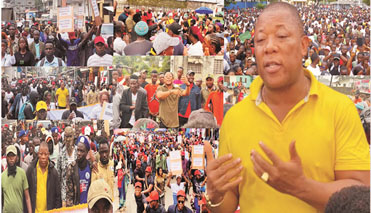
A battle line is seemingly expected to be drawn in three days’ time between the mass civil society movement called ‘STAND’ and the Unity Party-led government headed by President Joseph Nyuma Boakai.
STAND is an acronym depicting ‘Solidarity And Trust For A New Day,’ reportedly being supported by other civil society organizations in Liberia to protest against the Boakia-led regime for economic decline, increased unemployment and alleged government’s questionable transparency.
Dubbed: ‘Enough Is Enough’ a mass protest is planned for Thursday, July 17, 2025 in Monrovia when demonstrators are likely to march through principle streets of the city with placards depicting various inscriptions underpinning government’s conduct of the state of affairs.
STAND is chaired by the Coalition for Democratic Change (CDC) former National Chairman Mulbah Morlu, who became lead focal of the civil movement after he relinquished the party’s chairmanship before the conduct of the 2023 presidential and legislative elections.
The former CDC chairman being at the helm of STAND to take the UP regime to task for bad governance appears agitating to partisans, fanatics and supporters of the Governing Party on grounds that the UP ousted CDC from state power due to bad governance.
The CDC lost state power to the UP in 2023 for what the Boakai-led administration said was the former Governing Party’s inability to govern the country properly.
Critics of CDC, mostly loyalists and stanch partisans of UP do not support the July 17 protest on grounds that STANDS is advancing the former Governing Party’s political agenda under the canopy of advocating for the downtrodden masses.
From all indications, STAND seems to portray itself as a political push for opposition politicians against the UP-led government to right the wrong of governance, but there appears to be uncertainty over how many opposition political parties stand ready to grace the July 17 protest.
This uncertainty has slightly been proven by the disassociation of the Liberian People’s Party (LPP) to join STAND in the protest especially sensing that the movement is a maker of CDC that is also being considered a conduit of bad governance in Liberia.
However, the disassociation of LPP to the expected mass protest does not likely amount to a call-off to the constitutional right of the organizers of the planned civil demonstration against the government.
Critics who support the protest believe that mass demonstration by citizens against any sitting government is a tenet of democracy that should not be suppressed. They argue that those opposing the pending protest were in the immediate past orchestrators and organizers of protests in Liberia against bad governance.
It is recalled that in June 2018, there was a mass protest organized by the Council of Patriots (COP) under the stewardship of Henry Costa and others from opposition political parties including Unity Party, Liberty Party, Alternative National Congress, All Liberian Party and some civil society organizations over what was referred to as ‘Missing Fourteen Billion’ in government’s coffers at Central Bank of Liberia.
The protesters marched across Monrovia with petition to the offices of foreign missions near the capitol city, demanding the CDC-led government to account for the alleged ‘Missing Fourteen Billion’ from government’s coffers.
The protest resulted to government, with support from the US Embassy near Monrovia, inviting foreign audit firm to conduct a forensic audit on the claim. However, findings from the foreign audit firm hired did not establish that fourteen billion dollars got missing from government’s coffers, even though there were recommendations to improve on government’s financial system.
It is also recalled that in 2023 prior to the conduct of the presidential and legislative elections, another mass protest was organized by opposition political parties under the theme: ‘We Tire Suffering.’ The protest was meant to bring pressure on the CDC-led government that Liberians were suffering from the brunt of its bad governance posture and there was a compelling need for change to bring relief to the downtrodden masses.
Usually, in the wake of mass demonstrations in Liberia, organizers and the sitting government often tussle over the terms and conditions of the protests.
On the one hand, the government would insist on the clear intent and composition of the protesters to avoid chaos, injuries, deaths and national insecurity. On the other hand, organizers of protests would demand government’s authorization of peaceful assemblage to allow protesters under state security protection.
However, the masses, judging by past bitter experiences; sometimes exciting April 14, 1979 bloody Rice Riot in Liberia, often fear bloody nose and deaths should violence erupt at mass gathering of protest against government in denouncing bad governance in the country.