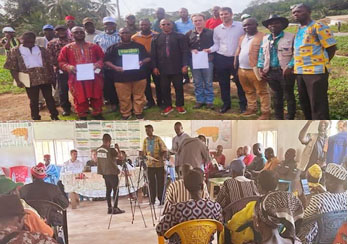
Sarbo Chiefdom and Cavalla Rubber Corporation (CRC), have signed a 15-year memorandum of understanding (MoU) on April 13, 2026.
The MoU aims to create the Sarbo Nature Reserve from rubber expansion to conservation.
The Agreement, valid from 2026, to 2041, with reviews every five years, will protect 2,123.94 hectares of high-carbon stock and degraded forest in River Gee Electoral District #3.
The signing ceremony at Sarbo Woffiken Town Hall, drew officials from the Ministry of Agriculture, Forestry Development Authority (FDA), civil society groups, Maryland and River Gee counties Superintendents, the press and community members.
From Rubber to Reserve, the deal follows a 2011, national concession to CRC, and a 2012, land allocation by Sarbo Chiefdom for rubber cultivation.
Of the 4,000 hectares planned, only 2,481 were suitable. A 2016, environmental assessment later identified high carbon stock forest within the concession. With global zero-deforestation commitments tightening, both parties agreed to convert the unplanted land into a protected reserve.
The Sarbo Nature Reserve aims to conserve biodiversity and critical ecosystems; restore degraded forest landscape; promote sustainable forest management; stop illegal logging, farming, hunting, and encroachment and support climate change mitigation.
A new Sarbo Nature Reserve Committee (SNRC), will supervise the project. Members include five Sarbo community representatives, five CRC/SIPH representatives, one FDA representative, and the River Gee County Agriculture Coordinator.
The SNRC will meet three times yearly to monitor compliance and is expected to become an independent legal entity within three years.
A Community-Based Forest Guards (CBFG) unit will also be formed to patrol the reserve, maintain buffer zones, control access points, and support conservation.
The MoU bans farming; hunting; land clearing, bush burning, and agrochemical use inside the reserve. It also mandates warning signs; monitoring systems, and community environmental education programs.
To reduce reliance on forest resources, the agreement provides: Annual compensation: US$5 per hectare for rice, cassava, banana, pineapple and vegetable production, plus market access help.
Community development fund: US$30,000 yearly. US$5,000 supports volunteer teachers in
Maaken, Woffiken, Geeken, Saykliken and Sweaken.
The remaining US$25,000 funds livelihood projects: Woffiken gets US$12,000; Sweaken and Geeken each get US$3,500; Maaken and Saykliken each get US$3,000.
According to the MoU, CRC will build and equip a health facility in Sarbo Woffiken, later turned over to the community and Ministry of Health.
FDA Region Five Coordinator, Evans Momodu Kiatamba, urged both sides to uphold their duties.
“The FDA owns the forest, while the community serves as custodians. We expect both the community and CRC to fulfill their responsibilities.”
Meanwhile, CRC/SIPH/SIFCA Executive Director, John Lootvoet, pledged full implementation of the agreement.
River Gee County Superintendent Mike Tarpeh Swengbe praised Sarbo Chiefdom for “choosing conservation over destructive exploitation,” and called on other communities to follow suit.
The MoU was signed by representatives from Sarbo’s five communities, including youth leaders, women reps, chiefs, and elders, alongside CRC Managing Director Marc Genot.
Witnesses included Swengbe, River Gee Agriculture Officer, Jasper Sheriff Tweh and FDA officials.