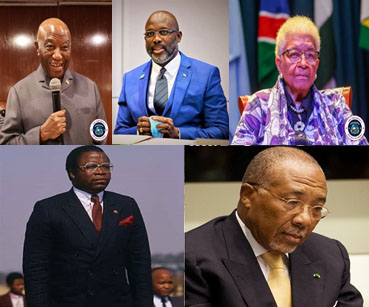
Liberians continue to decry the abandonment of national establishments- projects and exciting initiatives introduced by regime after regime while in power, aimed at uplifting the living standards of the country and its citizenry.
On April 12, 1980, state power slipped from the hands of the Elite Class that ruled the country for decades, when the so-called Natives consistently cried foul over how they (country people) were marginalized and suppressed.
“We have been freed from one party system. For too long we have not enjoyed our God-giving natural resources. Thank God one group of people will no more enjoy the resources and only be the gateway to our survival,” Liberians on the average who embraced the dethronement of the True Whig Party (TWP) long-lasting hold onto to state power at the time noted.
The predominantly natives’ national leadership under the military stewardship held by Master-Sergeant Samuel Kanyon Doe hit the ground fast-running, promising to zero down on injustice, abuse of power, human rights abuse, rampant corruption, nepotism, favoritism, and other practices of bad governance.
Ruled on the basis of decree, the military government eliminated hut tax, introduced national commune farm project; using local government officials to implement such self-food production project. The regime also ventured into attempts to ensure that Liberians pay the debts they owed United States of Americas long before the collapse of the TWP decadence of power.
This venture led the regime to call on the citizens to pay one dollar each towards the debts. On top of this , the regime printed what was referred to as ‘ Seven Corner’ five dollars coins as Liberia-owned legal tender in order to differentiate the US Dollar and the Liberian Dollar.
“The printing of the five dollars coins was the beginning of the unbending inflation in the country today, evident by the widened disparity between the US Dollar and the Liberian Dollar in circulation,” one financial expert has told the In Profile Daily in Monrovia.
Moreover, other establishments under the regime that are not in existence today; thus negatively affecting Liberians who invested into these initiatives include the Liberia Finance & Trust Bank and the Agriculture Cooperatives and Development Bank (ACDB). Depositors of these banks are said to still be increasingly frustrated over the losses because they cannot get back their monies as the banks are no longer in existence.
The name Charles Taylor stepped in as a ‘Liberator’ of Liberians from the tyrannical epoch of Doe through the unleashed civil war in Liberia on December 24, 1989 through Buutuo, Nimba County via Cote d’Ivoire.
This seems to be one of the worst and devastating periods in the country’s history because there was total anarchy characterized by lawlessness, abuse of power, human atrocity, mayhem; as every fabric of the society was in ruin.
Though the devastating civil war initially ended and proportional representation elections were held in July 1997, which Mr. Taylor was declared winner; under his regime, Liberia remained in the state of warfare until he forcefully went into exile in Calaba, Nigeria in August 2003.
Perhaps, the erection of an overhead foot path bridge linking the University of Liberia and the Capitol Building, and the construction of a modern plywood factory in Buchanan, Grand Bass County by OTC could have been some of what the regime would have counted on. However, the Ellen Johnson Sirleaf’s regime demolished the overhead foot path bridge while the rebel faction- Movement for Democracy of Liberia (MODEL) destroyed the plywood factory in Buchanan during the last fierce round of the civil war that forced Taylor into exile.
With the ousting of the administration of Taylor through pressure from dissidents forces, Madam Ellen Johnson Sirleaf took the mantle of power in 2006 through the ballot box. She led the country for two unbroken terms (2006-2017).
Madam Sirleaf with the overwhelming support of the international community in kind and cash, initiated lots of reform measures at various levels of all the sectors to benefit Liberians and take the country out of the dungeon of war.
However, critics have continued to claim that the regime was selective and class system prone, citing entrenched corruption which she vowed to fight becoming unbent while she allegedly shielded corrupt officials of her administration.
During the last term of Madam Sirleaf, there were public outcries over market projects that could accommodate marketers and their kids as the projects would have reportedly provided schools for kids while marketers would have benefitted from modern selling facilities at all selected localities in the country. Unfortunately, a number of those selected areas for constructions of those facilities were reportedly abandoned before the regime was over.
Having fought for the presidency since 2005, former football icon George Mannah Weah won the election in 2017. Like Madam Sirleaf’s regime faced Ebola crisis during her second term, Mr. Weah’s regime confronted the COVID crisis during his one term regime which the current governing Unity Party longed for.
Apart from continuing some of the unfinished Projects which Madam Sirleaf left behind; such as the Ministerial Complex in Congo Town, the World Bank sponsored road pavement project in Monrovia, Nimba, Lofa(kick-off), the Omega Market, etc, Mr. Weah constructed the 14 Military Hospital at the Barracks on RIA Highway and that of the one in Bopolu, Gbarpolu County.
However, his regime could not complete the construction of huge estate facilities began opposite the Barracks on RIA Highway while his regime’s much publicized coastal highway construction intended to link coastal cities across the country did not kick off when he was defeated by President Joseph Nyuma Boakai in 2023 during a closely contested race.
Now in the driver’s seat, President Boakai seems to be targeting a number of projects, but one major focus points to road connectivity. His regime’s controversial procurement of yellow machines to connect roads across the country is on course. Public parade of some of the equipment already brought into the country through the Freeport of Monrovia with each county name inscribed has been visible.
The regime seems to be restless in fighting corruption. At least he has sacked some officials caught being corrupt, but the scale of clampdown is being seen as insignificant until real giant economic vampires are brought down.
It is not clear how it may end, the Liberia-Guinea land dispute in Lofa seemingly stands embarrassing for the regime as critics claim that those responsible for the fallout have not been brought to book.
At the same time, the Housing Authority of the regime is said to be putting up bids for estate units for citizens to go after, depending on how much those in need can afford.
This drive is said to be based on prepayment arrangement, initially part payment of the total one may afford for any unite desired.
However, skeptics have surmised that while the initiative sounds good, there are risks involved that could lead citizens into putting pigs in bags as the possibility of the regime exiting before the actual project takes full swim cannot be ruled.
“These dreams from every regime are usually welcoming but the tendency of regimes preferring to initiate new projects without continuing what predecessors leave behind after their tenures, creates dark cloud and uncertainty for citizens to embrace some national development drives in the country,” one critic indicated.
Boakai, Weah, Sirleaf, Taylor, Doe