By Godgift Harris
Government has acknowledged inaccurate road statistics that were quoted in President Joseph Nyuma Boakai’s 2026 State of the Nation Address (SONA).
The inaccuracies have triggered renewed concerns about data integrity, internal coordination and credibility within the executive branch.
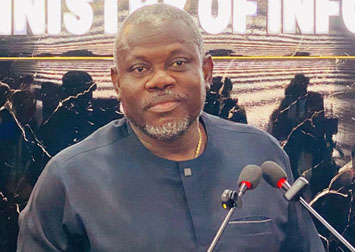
Information Minister Jerolinmek Matthew Piah admitted to the President SONA’s faults during the Ministry’s regular press briefing a day after Pres. Boakai addressed a Joint Sitting of the legislature.
In his nationally televised address, Pres. Boakai claimed that his administration had increased paved road network “from under 12 percent to at least 20 percent.”
Piah maintained “more than 780 kilometers of roads,” a statement widely circulated as evidence of progress in government’s infrastructure agenda.
However, Mr. Piah later disclosed that the figures cited by the President were misquoted, attributing the errors to inaccuracies in the speech preparation process, which relied on submissions from the Ministry of Public Works.
According to Piah, the version of the speech delivered by the President “did not accurately reflect the ministry’s submission.”
He confirmed that the executive mansion has since revised the official text of the address to reflect what the government now says is the correct information.
The amended version states that the administration has taken steps toward reducing the paved road deficit to 20 percent, and has maintained approximately 783 kilometers of major road corridors nationwide language that critics say, significantly differs from the original claim of achieved progress.
While the government has portrayed the correction as an act of transparency, governance analysts argue that the incident exposes deeper weaknesses in policy coordination, data verification, and internal quality control within the executive.
Observers warn that errors in a constitutionally mandated national address are not minor oversights, but serious lapses that undermine public trust, particularly at a time when many Liberians remain skeptical of official performance claims amid persistent infrastructure and service delivery challenges.
Civil society organizations spoke of this year’s SONA, which addressed are formal accountability instruments, not campaign-style speeches, and must be grounded in thoroughly verified facts.
Any inaccuracies, they argue, risk reinforcing perceptions of governance driven more by rhetoric than by measurable outcomes.
Although some Liberians have commended Mr. Piah for publicly admitting the mistakes, others insist that accountability should extend beyond acknowledgment.
Critics argue that officials responsible for drafting and vetting the President’s speech must be held answerable to prevent a recurrence of such errors.