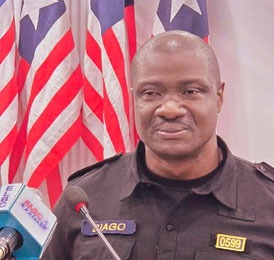
The Liberia Drugs Enforcement Agency (LDEA), charged with leading the nation battle against illicit drugs, is being systematically crippled by neglect, poor funding and internal dysfunction.
The Agency new Officer-in-Charge (OIC) Fitzgerald T. M. Biago, made the disclosure over the weekend at the Ministry of Information regular press briefing.
Biago painted a damning picture of an institution expected to take on well-financed drug cartels, but left to operate with salaries as low as US$150 per month, no uniform, no health insurance and functional logistics.
He warned that without urgent reforms, the LDEA risks becoming a ‘symbolic agency rather than being an agency with effective force in the fight against country’s worsening drug crisis.
The OIC described the Agency wage structure as “demoralizing and exploitative,” noting that US$150 cannot sustain a family, let alone motivate officers to risk their lives confronting armed drug traffickers.
“This fight is for all Liberians, no matter your status. But without resources, LDEA will remain on the losing side,” Biago said.
One of Biago’s most alarming disclosures was that LDEA officers operate without health or life insurance, leaving their families exposed if they are injured or killed in the line of duty.
The lack of uniforms, vehicles, surveillance tools, and protective gear, he added, further undermines the Agency operational ability.
“These are not small issues,” Biago said, adding: “If officers are to confront drug cartels, the state must properly empower them.”
Biago also hinted at entrenched corruption within the Agency, revealing that some individuals operate without official employment, but remain on the payroll due to connections with ‘big heads’ inside the LDEA.
He warned that such patronage undermines professionalism and weakens accountability at a time when the drug epidemic demands integrity and discipline.
Observers say Biago’s statement is an indirect admission that political interference continues to rot country’s security institutions from within, leaving frontline officers vulnerable and the public unprotected.
The drug crisis has spiraled in recent years, with narcotics like “Kush” devastating communities and fueling crimes, particularly among the young people.
Civil society groups and community leaders have repeatedly sounded the alarm, calling for urgent government intervention.
With these concerns, Biago framed the struggle as a national fight requiring joint security collaboration and public support, urging institutions like the Liberia National Police, the Liberia Immigration Service, and the National Fire Service to work closely with the LDEA.
While Biago praised President Joseph Nyuma Boakai for prioritizing the anti-drug campaign, he insisted that rhetoric must be matched with resources.
His remarks raise serious doubts about government’s willingness to invest in what many now regard as the country most pressing social crisis.
As drug abuse spreads and traffickers exploit weak enforcement, critics argue that without higher salaries, better logistics, institutional reforms, and independence from political manipulation, the LDEA cannot win the fight.
For now, the frontline anti-drug force remains under-staffed, under-funded, and unprotected a fragile shield against a deepening national emergency.