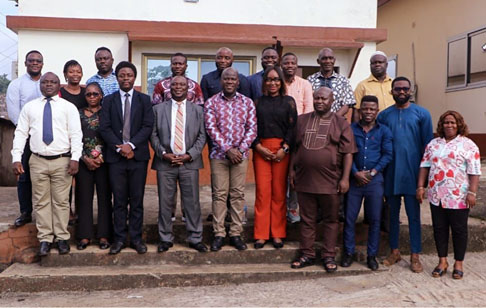
Liberia and Sierra Leone are to formalize a landmark Environmental Cooperation Pact.
This follows a successful three-day South-South Learning Exchange in Freetown that deepened bilateral collaboration on shared climate and environmental challenges.
The high-level exchange, held from October 6–8, 2025, convened senior leadership and technical experts from both Environmental Protection Agencies (EPAs) to advance policy dialogue, share best practices, and chart a roadmap for sustained regional action. The closing session at the New Brookfields Hotel, according to a release, culminated in strong commitments to jointly address deforestation, coastal erosion, biodiversity loss, and the escalating impacts of climate change.
At the close, Anthony S. Kollie, Acting Deputy Executive Director and Head of Delegation for EPA Liberia, hailed the engagement as a milestone in regional environmental diplomacy.
“Over the past three days, we have shared not only experiences but also visions—visions of resilient nations, empowered institutions, and sustainable futures for our people,” he said. “This engagement has been a true reflection of African solidarity and collaboration rooted in mutual respect and a shared determination to address the pressing environmental and climate challenges that confront our region.”
Discussions spanned the domestication of multilateral environmental agreements, governance and enforcement, waste and chemical management, environmental data systems, National Adaptation Plans, and green economy initiatives. Liberia drew lessons from Sierra Leone’s integration of environmental management into national development planning, while sharing its own experience in policy formulation, ecosystem restoration, and sustainable land management.
Both agencies agreed in principle to formalize their partnership through a Memorandum of Understanding (MOU) that will institutionalize cooperation. The framework will prioritize:
Knowledge and data sharing to strengthen the exchange of scientific information, best practices, and lessons learned.
joint capacity development through training, research, and staff exchanges.
Collaborative projects targeting cross-border issues such as forest conservation, marine and coastal protection, and waste management.
Enhanced climate action and policy alignment to advance regional and global commitments under the Paris Agreement and other Multilateral Environmental Agreements.
Kollie noted that the two agencies are working toward signing the MOU during COP30 of the UNFCCC in Belém, Brazil, later this year. “By signing this MOU on the global stage, we aim to demonstrate that regional cooperation is indispensable to achieving the Sustainable Development Goals and the objectives of the Paris Agreement,” he said.
On behalf of Dr. Emmanuel Urey Yarkpawolo, Executive Director and CEO of the Environmental Protection Agency of Liberia, Kollie extended appreciation to the Government and people of Sierra Leone for their hospitality, and commended EPA Sierra Leone’s leadership and staff, alongside the Ministry of Environment and Climate Change and the Sierra Leone Meteorological Agency, for their support. “As we close this chapter of our exchange, let it be the beginning of a stronger and more enduring relationship between our two agencies,” he added.
Reaffirming Sierra Leone’s commitment, Mr. Sheku Mark Kanneh, Chief Director of EPA Sierra Leone, underscored the power of South-South collaboration. “We share similar environmental challenges, and this collaboration builds on a legacy of cooperation that includes initiatives like the Upper Guinean Forest Conservation Project,” he said, confirming agreement to draft the MOU, define priority areas, and maintain regular coordination to ensure follow-through.
Across three days, delegates engaged in technical sessions to enhance institutional capacity and mutual understanding. Day one featured a courtesy visit to EPA Sierra Leone and a meeting with the Ministry of Environment and Climate Change on integrating environmental policy into national development plans, as well as exchanges on NDCs, NAPs, and the Montreal Protocol. Day two centered on compliance, chemical and waste management, public awareness and education, and policy development, alongside concept notes for joint projects on transboundary freshwater management, plastic waste reduction, youth innovation, and climate-security initiatives. The final day focused on accessing climate finance through the GEF, GCF, and Adaptation Fund, as well as sharing progress on carbon readiness for participation in Article 6 carbon markets.
Key outcomes included a draft framework for ongoing collaboration, stronger professional networks among technical experts, and plans for a joint side event at COP30 in Brazil and at the UN Convention on Biological Diversity COP in Armenia.