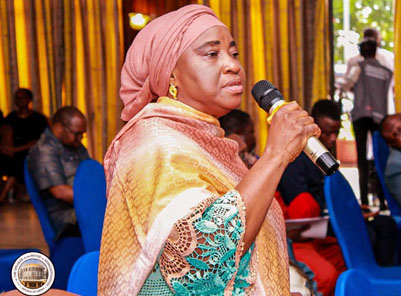
“My two years in office has been characterized by infrastructural investment, educational empowerment, and community engagements,” Rep. Feika.
Legislative Sojourn is a Column produced by the Inprofile Daily Newspaper on a weekly basis, which seeks to highlight legislators from the fifteen counties and the seventy- districts on their profiles, prospects, challenges, and way forward as to enable the Liberian people get some insights on the workings of those they entrusted to the manage the country.
Today’s edition focuses on the prospects, challenges, workings and way forward of Grand Cape Mount County District #3 Representative Gbessie Sonii Feika.
In just two years at the legislature, Rep. Feika is boasting of series of genuine development and women’s empowerment initiatives.
Rep. Feika told this column that since she took office in January, 2024, she has embarked on an ambitious and multifaceted journey to revitalize the district through a series of targeted development initiatives that are currently impacting lives of the locals.
With a focused mind on transforming the district, Rep. Feika approach has been both pragmatic and visionary, thus addressing foundational needs in infrastructure, education, health, and religion, while also fostering social cohesion and community empowerment.
Also, with analysis details on key projects undertaken, their implementation, and their impact on the district, the female lawmaker has one of her development agendas as enhancement of social infrastructure. The project is in Tewor, and its catchment communities.
Rep. Feika named the construction of nurses and teachers’ quarters that became necessary to curtail challenges the professionals often face in finding comfortable lodging whenever they are assigned in the district.
The project has also attracted qualified professionals to rural areas and ensure their stay.
To improve healthcare delivery, Rep. Feika has provided comfortable and secured accommodations for nurses assigned in Tienii and its environs.
This initiative has also reduced absenteeism among nursing staff, increased confidence, and translated into better health outcomes, especially in maternal and child health.
In educational advancement similarly with nurses, the teacher quarters will address the longstanding issue of teacher shortages in the district, improving living conditions of teachers, and encourage them to commit to longer terms in Tewor District, resulting in better continuity in learning and higher students’ performances.
“The presence of stable residential facilities has also increased the appeal of the local school system, encouraging higher enrollment from the urban area to move in the district,” Rep. Feika said.
Bridge Construction and Hand Pumps: She has also constructed a major bridge in Gussay, the hometown of former Representative, Emmerson Kamara.
At present, many rural communities like Gussay, and surroundings that were isolated during the rainy season, are now getting access to social services due to the construction of the bridge, thereby minimizing the challenges.
“As we speak, the new bridge constructed in Gussay has transformed daily lives of the people by connecting surroundings, especially remote villages to major roads and urban centers. This infrastructural improvement has also fostered trade, enabled small businesses to expand their reach, and made it easier for farmers to transport their produce to markets, thereby boosting local economies. It has also buttressed the reduction in travel time, and increased safety for children attending school, pregnant women seeking medical attention, and traders commuting to markets,” Rep. Feika said.
For such development initiatives, residents have expressed gratitude, mainly for the bridge, which they consider a lifeline, particularly during heavy rains when rivers overflow.
Rep. Feika named the construction of hand pump in York Island Community, and other communities that are now preventing residents from fetching unsafe water from the creeks.
Educational empowerment Understanding that education is the cornerstone of sustainable development, Rep. Feika also launched a comprehensive scholarship program immediately upon taking office.
The scheme targets underprivileged, but talented youth from the county.
The scholarship program covers tuition, textbooks, and in some cases, transportation for students from ‘marginalized’ backgrounds.
“I also focus on merit and need, because the scholarship initiative nurtures a pipeline of future leaders, professionals, and entrepreneurs, who are expected to contribute positively to the district growth. It is upon this back drop I do community involvement where parents, and community leaders are engaged in the selection process, ensuring transparency and ownership of the initiative,” she said.
Recognizing the importance of dialogue, civic participation, and access to public services, Rep. Feika, has overseen the construction of town halls in four separate communities, namely: Borma, Sawelor, Tewor and Meimassa, as such, these town halls currently serve as epicenters for community meetings, conflict resolution, and dissemination of government programs. These programs have fostered greater transparency and cooperation between local authorities and residents. The town halls are being used as double venues for cultural festivals, youth empowerment and for hosting workshops.
To promote religious tolerance, Rep. Feika has constructed mosques in five communities.
“Commitment to religious pluralism and social harmony, is reflected in the construction of mosques in other communities that included Bowula, Fassa and Kpallan. The aim is to support both spiritual and communal well-beings.
“By investing in places of worship for the Muslim population, it is my own way of strengthening interfaith relations that underlined the importance of inclusion in governance, because, the new mosques will serve, not only as religious centers, but also platforms for literacy classes, conflict mediation, and charitable activities, thereby weaving stronger social bonds among residents.”
The mosques have become places for distributing food during Ramadan and other emergencies, highlighting a holistic approach to development.
Empowerment of women and youth through educational opportunities and engagement in governance, strengthened local economies through infrastructural and market improvements, but said, there are challenges ahead. This means ensuring sustainability and maintenance of new infrastructure, scaling up scholarship opportunities to reach more disadvantaged youth to fostering unity in communities with diverse religious and ethnic identities, mobilizing additional resources for future projects in every town and village.