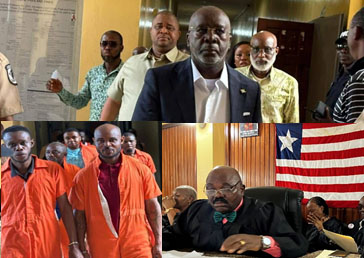
The Criminal Court ‘A’ Judge Roosevelt Z. Willie, has denied a motion filed by Arthur T. Johnson, lawyer representing the defendants in the arson case.
Johnson’s motion seeks to suppress evidence of defendants accused of criminal offenses.
In a ruling delivered earlier Wednesday, September 24, 2025, Judge Willie rejected the defense motion to suppress the evidence, stating that while the medical report raises serious concerns, it does not, on its own, meet the legal threshold required to exclude the evidence in question.
“Based on the issue, and the law cited,” Judge Willie declared: “The motion to suppress evidence is hereby denied.” He further ordered that the trial will proceed this Friday, September 26 as scheduled. The defense has taken exception to the ruling, and indicated its intention to pursue statutory remedies, potentially including an interlocutory appeal or a writ of prohibition to the Supreme Court. Before the ruling, during arguments, the defense also challenged the legality of the National Security Agency’s (NSA) involvement in the investigation.
Defense counsel through Wilkins Wright, argued that under the Act establishing the NSA (2011), the Agency is authorized only to engage in clandestine operations, and not to conduct criminal investigations of the nature currently before the court.
In its response to the defense motion, the prosecution, through Richard Scott, argued that all evidence, including confessions and material exhibits, was collected lawfully and voluntarily.
Cllr. Scott insisted that the involvement of specialized agencies (NSA and LPRC), was crucial in piecing together complex elements of the case, and did not violate due process.
“The prosecution maintains that the medical report, while concerning, does not negate the legal procedures that were followed during the investigation,” said the lead government attorney during arguments.
However, the court ruled against the defense, referring to Section 2(d) of the 2011 NSA Act.
Judge Willie stated that the NSA is legally empowered to assist other law enforcement bodies, especially in cases where the Liberia National Police (LNP) may lack the technical capacity to conduct specialized aspects of an investigation.