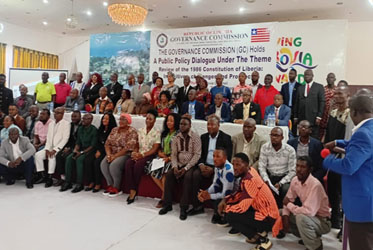
The Governance Commission (GC) in collaboration with the Law Reform Commission (LRC), has launched a national dialogue to review the 1986 Constitution under the theme: “Review of the 1986 Constitution of Liberia: Imperatives, Challenges and Prospects.”
The two-day public policy dialogue, held at Monrovia City Hall on June 10, 2026, brought together legal scholars, lawmakers, governance experts, policymakers, development partners, diplomats, including civil society actors, and other stakeholders to examine critical issues surrounding constitutional reform and the future of governance.
The forum is intended to provide a platform for discussions on the strengths and weaknesses of the current constitution, and to generate recommendations that will guide future constitutional reform efforts.
Acting Chairman of the Governance Commission, Alaric K. Tokpa, emphasized the importance of constitutional reform in strengthening democratic governance, and ensuring that the supreme law reflects contemporary realities and the aspirations of its citizens.
Tokpa said, every Liberian should have a voice in the constitutional review process.
He said the dialogue seeks to foster informed national conversations on governance issues, and create a pathway for broader public engagement in constitutional reform discussions.
Law Reform Commission Chairperson Bornor M. Varmah, underscored the need for an inclusive review process that reflects the rights, interests and concerns of all Liberians.
Varmah said, constitutional reform should be driven by the national interest rather than partisan or sectional considerations.
He called on politicians, students, market associations, business groups, and other sectors of society to actively participate in the process, stressing that constitutional reform must be a collective national undertaking.
Governance Commission Executive Director Jallah C. Kesselly delivered the first presentation.
Kesselly highlighted the need for a comprehensive review of the 1986 Constitution.
He argued that constitutional reform remains essential to strengthen accountability, promote democratic governance, and address emerging challenges.
The dialogue also focused on ambiguities and limitations within the current constitutional framework, including an assessment of the Constitutional Review Committee report chaired by former Chief Justice Cllr. Gloria Musu-Scott.
Participants examined inadequacies in the constitution’s amendment provisions, challenges affecting constitutional reforms and strategies for advancing the review process.
Discussions also explored the historical and theoretical foundations of constitutional reform and the conditions necessary for successful constitutional change.