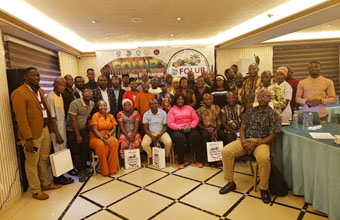
The Food Systems, Land Use and Restoration (FOLUR) Project successfully concluded a two-day Knowledge Exchange and Business Symposium, bringing together government institutions, farmer representatives, development partners, financial institutions, private sector actors, civil society organizations, and implementing partners to strengthen collaboration for sustainable agriculture, forest conservation, and green investment in Liberia’s Northwest Landscape.
The FOLUR Liberia Project team includes Conservation International (CI), the Royal Society for the Protection of Birds (RSPB), the Society for the Conservation of Nature of Liberia (SCNL), and Fauna & Flora (F&F).
The event featured a Knowledge Exchange and Learning Session on the first day and a Business Symposium on the second day. Together, the sessions provided a platform for sharing practical experiences, identifying solutions to common challenges, and fostering partnerships to accelerate sustainable cocoa and oil palm production while protecting Liberia’s forests.
Opening the event, David Dennis, Senior Program Manager at CI, welcomed participants and commended their commitment to strengthening collaboration across the agricultural and environmental sectors. He described the two-day engagement as an important opportunity to exchange knowledge, build partnerships, and identify practical solutions for achieving sustainable landscape management in Liberia.
The first day focused on peer learning and technical knowledge exchange among farmers, government agencies, and project partners. Participants reflected on lessons from project implementation, shared practical experiences, discussed challenges affecting sustainable production, and explored opportunities to strengthen climate-smart agriculture, community governance, land restoration, and sustainable value chains.
Technical sessions highlighted good agricultural practices, forest conservation, restoration approaches, cooperative development, commodity regulation, and strategies for improving productivity while reducing deforestation. Participants also emphasized the importance of stronger collaboration between communities, government institutions, and development partners to sustain project outcomes.
Representing Lofa County Senator Momo T. Cyrus, Arthur Kowah, Chief of Office Staff, underscored Liberia’s rich natural resources and emphasized the importance of protecting these assets for future generations. He noted that environmental degradation continues to contribute to poverty, displacement, and increased pressure on natural resources, while describing the FOLUR Project as a timely initiative that promotes sustainable agriculture, restores degraded landscapes, and strengthens local capacity.
The second day shifted attention to investment, business partnerships, and policy dialogue aimed at creating sustainable market systems for Liberia’s cocoa and oil palm sectors. Discussions explored practical approaches to mobilising finance, strengthening market linkages, improving commodity traceability, and creating enabling conditions for responsible private sector investment.
In his opening remarks, Michael F. Garbo, Executive Director of SCNL, welcomed participants and commended them for their active participation in the interactive dialogue, emphasizing the importance of collaboration and knowledge sharing in advancing sustainable landscape management.
Speaking at the symposium, Roger Emmou, Director for West and Central Africa at CI, encouraged stakeholders to transform sustainable agricultural practices into viable business opportunities that attract long-term investment.
“We have to make a clear difference between an income-generating activity and an investable opportunity,” he noted, emphasizing the need to unlock finance and develop competitive value chains that benefit farming communities while conserving forests.
Panel discussions brought together representatives from government, financial institutions, the private sector, and development organizations to examine opportunities for expanding sustainable sourcing, off-take arrangements, blended finance, and public-private partnerships. Discussions also highlighted the importance of creating an enabling policy environment to support responsible investment in forest-friendly agricultural commodities.
Participants further emphasized the need to improve farmers’ access to finance, strengthen cooperatives, expand digital inclusion and digital services for farmers, improve market information systems, enhance quality assurance and regulatory compliance, and build stronger partnerships among government, the private sector, and development partners. These actions were identified as critical to improving productivity, increasing incomes, and ensuring Liberia’s agricultural commodities remain competitive in emerging international markets.
The symposium also reinforced the importance of preparing farmers and cooperatives to meet evolving market requirements, including traceability and sustainability standards, while promoting inclusive participation of women and youth across agricultural value chains.
The FOLUR Liberia Project works directly with farming communities to strengthen sustainable cocoa and oil palm production, restore degraded landscapes, conserve forests, and improve rural livelihoods. The project currently supports nine clans across Lofa, Grand Cape Mount, and Gbarpolu Counties—Lower Guma, Bondi, Zeyeama, Seivula, Fanhbulle, Passawe, Zodua, Bondi, and Bondi-Mandingo—reaching more than 101,000 people and covering over 268,000 hectares of landscape through Conservation Agreements that support sustainable land-use planning, restoration, and community-based natural resource management.
The two-day engagement concluded with a renewed commitment from participants to strengthen collaboration, mobilize investment, and translate dialogue into concrete actions that will accelerate sustainable agricultural development, improve rural livelihoods, and conserve Liberia’s globally important forest landscapes.