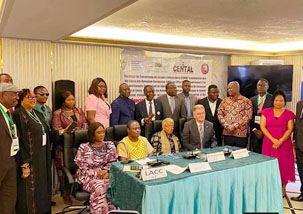
Former President Ellen Johnson Sirleaf, has renewed her call for the establishment of a specialized national anti-corruption court.
Madam Sirleaf warned that the fight against corruption will continue to fall short “unless investigations are followed by swift prosecutions and meaningful convictions.”
She delivered the keynote address at the National Anti-Corruption Policy Dialogue.
The dialogue was held on Tuesday, June 30, 2026, at a resort in Monrovia.
Madam Sirleaf said, corruption continues to undermine public trust, weaken state institutions, and slow national development, “because many high-profile corruption cases have failed to reach credible conclusions in courts.”
She argued that while corruption scandals are frequently exposed, few offenders are ultimately held accountable, creating a culture of impunity.
The dialogue was organized by the Center for Transparency and Accountability in Liberia (CENTAL) in partnership with Naymote Partners for Democratic Development and the Center for Democratic Governance with support from the Government of Ireland’s Development Program.
It was held under the theme: “Strengthening Transparency and Accountability in Through the Establishment of a Specialized National Anti-Corruption Court.”
The event brought together senior government officials, diplomats, civil society organizations, anti-corruption institutions and development partners to build national consensus for the creation of the proposed court.
As of her 12 years regime, Madam Sirleaf recalled that corruption was deeply entrenched when she assumed office in 2006.
She highlighted reforms undertaken during her presidency, including strengthening the independence of the General Auditing Commission, establishing the Liberia Anti-Corruption Commission, creating the Financial Intelligence Unit, promoting the Open Budget Initiative and implementing public financial management reforms to improve transparency and accountability.
Despite those reforms, Madam Sirleaf admitted that the anti-corruption framework remains incomplete, “because institutions responsible for investigating corruption often lack an effective judicial mechanism to ensure that offenders are prosecuted and punished.”
Many investigations, she said, lose momentum once they reach the courts, weaken public confidence in the justice system and reinforce the perception that “corruption is rarely punished.”
She said, a specialized national anti-corruption court would complement existing oversight institutions by ensuring corruption and economic crimes are handled efficiently, fairly, and without unnecessary delays.
Madam Sirleaf urged President Joseph Nyuma Boakai to urgently advance the establishment of the court through executive action while calling on the Legislature to enact the required legislation.
She also appealed to the Supreme Court to strengthen judicial performance, and restore confidence in the justice system.
As a former president, Madam Sirleaf further challenged civil society organizations to intensify public awareness campaigns and encouraged the private sector to reject corrupt business practices.
She stressed the need for transparency and accountability attract investment, promote sustainable economic growth, and restore confidence in public institutions.