By Godgift Harris
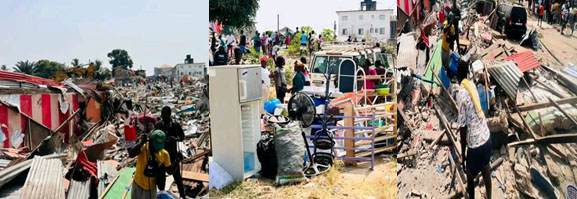
Hundreds of residents along 4th and 5th streets in Sinkor, have been rendered homeless.
This incident followed a court-authorized eviction that critics say exposes government’s persistent failure to protect vulnerable urban communities from the humanitarian fallout of land disputes.
The eviction, carried out in favor of a private landowner, saw homes demolished, and personal belongings hurled into the streets, according to eyewitnesses.
Families reported losing essential household items, important documents, and personal savings, leaving many with nothing, but the clothes they were wearing.
Residents say the operation was executed with little or no prior notice, and without any relocation plan or social protection measures, despite Liberia’s long-standing history of contested land ownership and forced evictions.
Women, children and the elderly, are now sleeping outdoors or relying on relatives and neighbors for temporary shelters.
“We respect the law, but the law should not throw people into the streets without alternatives,” said one displaced resident.
“The government knew this problem existed, but did nothing until it exploded in such disgraceful manner.”
Human rights advocates argue that while court rulings must be enforced, the state has a constitutional obligation to mitigate the humanitarian consequences of such actions particularly in densely populated urban areas like Sinkor, where affordable housing options are limited or nonexistent.
As of press time late last night, there were no official statement from the Ministry of Justice, the Liberia Land Authority, or the Ministry of Gender, Children and Social Protection outlining any coordinated government response to the crisis.
The silence, critics say, reinforces concerns about institutional neglect and weak urban governance.
In the absence of an immediate national response, Montserrado County District #8 Representative Prince A. Toles, announced a personal intervention, committing L$ 3.5 million to provide emergency relief to affected families in the Saye Town Community.
While the Toles’ gesture has been welcomed by residents, civil society actors argue that it highlights a deeper structural problem.
“This is not sustainable,” one civil society advocate said. “Humanitarian relief should not depend on the goodwill of a single lawmaker when evictions of this scale are predictable and preventable.”
A displaced resident, Joseph Johnson, said the community had no prior awareness that an eviction was imminent.
Another victim, Mary Snowe, described the ordeal as devastating, noting that families lost monies and household items, and now face uncertainty over their children’s education.
“Our children are supposed to be in school on Monday, but everything is gone. We are deeply disappointed.
As displaced families continue to appeal for government intervention, the Sinkor evictions have reignited national debate over land governance, urban planning, and the state’s preparedness to balance property rights with basic human dignity.
Observers warn that without urgent policy reforms, stronger social safeguards, and coordinated institutional action, similar crises are likely to repeat across Monrovia.