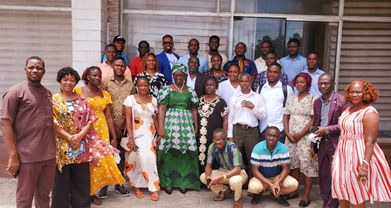
Actionaid Liberia, with funding from Plan International, through the Global Fund Program, has ended a day-long Capacity Assessment Findings Validation workshop held in Monrovia.
The workshop, was hosted for over 30 civil society organizations and Community-Based Organizations (CSOs/CBOs), was part of the Global Fund’s Resilient and Sustainable System for Health (RSSH) grant implementation.
The Validation initiative marks a critical step in the process, aimed at reviewing and validating the findings from the capacity assessment, and proposed capacity-building plans.
With support from the Global Fund, CBOs have played a vital role in the broader health system by providing essential services such as, health, education, testing and treatment, adherence support and advocacy.
Their community-based approach fosters trust and encourages health-seeking behaviors among populations that may otherwise hesitate to access formal healthcare services due to stigma, discrimination, or fear of punitive measures.
CBOs have served as a bridge between marginalized communities, and national health systems, ensuring that these populations’ voices are heard in health policy discussions and decision-making processes.
On Thursday, September 18, 2025, Actionaid Business Development Manager, Madam Victoria Torlor-Koiquo, told participants that the project main objective is to strengthen the organizational and technical capacities of CSOs/CBOs across the country to effectively contribute to the health sector.
She said the initiative seeks to validate the capacity assessment findings, and proposed interventions with participating CSOs/CBOs; ensuring that they aligned with their organizational needs and priorities.
“The selected CSOs/CBOs will be empowered to respond more effectively to health and other community programs in their communities,” said Madam Koiquo.
She said the validated organizational Capacity Building Plans for each CSO/CBO feedback will be incorporated into final training, and mentorship plans, as the workshop report will document key discussions and recommendations.
Madam Koiquo said it has been observed that 100 percent of CSOs are legally registered as local organizations; 83 percent or 24 of them have Human Resource (HR) policies, and all of the CSOs missions are aligned with the fight against HIV/AIDS, TB and Malaria, while 100 percent of them have board structure.
“Sixty-two percent or 18 of the CSOs have Strategic plans, 28 percent or 8 of the CSOs reported having staff performance appraisal.
Fifty-five percent or 16 of the 29 CSOs reported having some form of written project management tools. All CSOs reported having a financial policy and procedure manual in place,” she said.
Fourteen percent or 4 of the CSOs business registration have expired. Many CSOs HR policies are not fully practice due to lack of funding.
Twenty-two percent or 4 of CSOs have expired Strategic plans, and thirty-eight percent or 11 CSOs don’t have strategic plans.
Twenty-eight percent or 8 CSOs don’t have standardized staff performance appraisal tools.
Madam Koiquo said there is no evidence that all CSOs staffs are fully aware of the financial policy, and procedure being used by their institutions.
Liberia Coordinating Mechanism (LCM) Executive Director, Gabriel C. Stans, who officially declared the ceremony opened, said the capacity-building assessment is an initiative that they from the end of LCM, have advocated for in order to build the needed capacity of the CSOs.
Stans said the training is intended to fully equipped the CSOs with the necessary knowledge and skills, in preparing them to take over the sector in the future when the international CSOs are no longer in the country.
“I want to take this time to officially welcome all of you to this validation workshop, this is a long-awaited initiative, but thank God that we have reached this point.
“By the grace of God, we have succeeded in this advocacy, and the Global fund have allotted some funding for the capacity-building of about 35 CSO.”
Actionaid Liberia former country director, Ernest K. Gaie, said the knowledge and skills that CSOs will acquired from the day-long engagement, will be very important in building and strengthening the capacity of their respective organization.
“A lot of you have realized that international organizations are now looking more into the “local content.” And so, you will have to step up and start performing some of the works, and responsibilities that Actionaid, and some of the other international organizations have performed,” Gaie said.
“Money will come, but first you have to put your best forth and have a product that you market.”
Through its partnership with CBOs, the Global Fund is committed to fostering an inclusive approach to health service delivery that prioritizes the need of key and vulnerable populations (KVPs).
This commitment aligns with the Global Fund’s broader mission to ensure that everyone, regardless of their circumstances, has access to high-quality health services.
Ongoing investments and capacity-building initiatives are critical for enhancing the sustainability and effectiveness of health programs in Liberia, thus contributing to country’s goal of achieving universal health coverage and improved health outcomes for all citizens.
In line with this, Actionaid Liberia was engaged by Plan International, to conduct a comprehensive capacity assessment and capacity-building initiative for 36 CBOs across eight counties.
This initiative will first assess the existing capacity gaps, followed by the implementation of targeted interventions to address the identified challenges.