By Julius Konton
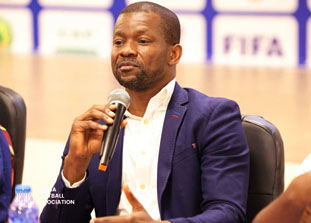
The President of the Liberia Football Association, Mustapha Raji, has mounted a robust defense of his administration’s record, outlining sweeping reforms, infrastructure investments, women’s football expansion, and governance modernization.
Raji spoke during a wide-ranging address at the LFA’s Extraordinary Congress before delegates, club officials, government representatives, and international partners.
He framed football development as both a national unifier and an economic tool, urging stakeholders to prioritize long-term growth over short-term political disputes.
“Football development is not an overnight process. It requires innovation, discipline, integrity and collective responsibility,” Raji said.
He revealed that when his administration assumed office in 2018, Liberia had only three certified coach educators nationwide. Today, that number has grown to over 26, supported by local stakeholders and international partners. Yet, he warned the progress remains insufficient for a country of more than five million people, where football is the most popular sport.
Former national team stars, including James Debbah and Kelvin Segbe, have returned to contribute as coach educators; an initiative Raji described as essential to sustainability and local capacity building.
Raji credited past LFA leadership for laying the groundwork for today’s reforms, particularly:
Edwin Melvin Snowe, Jr., under whose tenure Liberia installed its first artificial turf at the Antoinette Tubman Stadium (ATS).
Cllr. Sumo Izetta Wesley, Africa’s first female football association president, who refurbished the ATS and expanded artificial pitches to Kakata, Margibi County.
Musa Hassan Bility, who advanced the vision of a national football center of excellence.
That vision materialized as the George Weah Technical Center, now reinforced under Raji’s leadership with renovations, fencing, a mini-stadium, and the establishment of the Henry N. Browne Academy, aimed at producing elite talent for national and international football.
Raji highlighted one of his administration’s most visible achievements: the rapid expansion of women’s football.
Women’s teams increased from eight teams in one league to over 30 clubs nationwide.