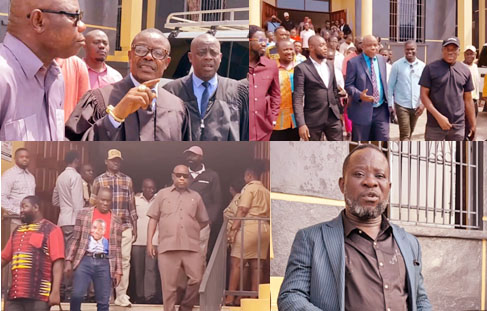
The defense key witness failed to establish which security entity received the money, ‘because we not inform investigators, which national security agencies received what allocations of the amounts.’
The high-profile US$6.2 million corruption trial involving former Finance Minister Samuel D. Tweah, Jr. and four other ex-officials took a dramatic turn on Friday, April 3.
The drama involves prosecution’s lead witness, who struggled to defend critical elements of the case under intense cross-examination.
Baba Mohammed Boika, Program Manager at the Liberia Anti-Corruption Commission (LACC), conceded under questioning that investigators did not trace how the disputed funds, approximately L$1.055 billion (about US$5.4 million) and an additional US$500,000 were ultimately used.
The funds, allegedly transferred from government accounts between September 8 and 22, 2023, for “joint security operations” ahead of the elections, were neither appropriated by the Legislature nor deposited into an official National Security Council account, Boika testified.
However, when pressed by defense counsel Arthur Johnson, Boika admitted that the LACC could not establish whether the money was personally misappropriated or who ultimately received it.
“We were investigating an act of corruption. The defendants could not inform investigators which national security agencies received what allocations. On that basis, we moved forward with the indictment,” Boika told the court.
Defense Challenges Foundation of Case
The admission gave the defense an opening to attack the prosecution’s core argument.
Cllr. Johnson, argued that without tracing the flow of funds or proving personal gain, the state cannot sustain a charge of theft.
“If investigators did not trace or document how the funds were disbursed or applied, then on what basis did they conclude the funds were stolen?” he asked.
Legal observers say the gap could prove fatal to the prosecution’s case, particularly as it appears to rely heavily on the defendants’ inability, or refusal to explain how the funds were spent.
Contradictions in Testimony
Boika’s testimony revealed internal inconsistencies that further weakened the prosecution’s position.
While he initially claimed investigators were “not interested” in the operational breakdown of expenditures, he later acknowledged that investigators did in fact seek details on how funds were distributed among security institutions.
Analysts say that contradiction undermines the credibility of the investigation.
“You cannot build a theft case on a defendant’s refusal to explain expenditures when your own investigation did not pursue that explanation,” one legal practitioner noted.
National Security Argument Emerges
The defendants, former senior security officials, reportedly invoked national security concerns to withhold details about the expenditures.
Boika confirmed that this refusal became a basis for the indictment.
But legal experts caution that silence, particularly when tied to national security, does not in itself constitute proof of theft or criminal intent.
A separate dispute emerged over whether the Financial Intelligence Agency (FIA) was legally part of the Joint Security framework at the time of the transactions.
Boika claimed the FIA’s inclusion stemmed from a 2023 letter by former National Security Advisor Jefferson Karmoh to former President George Weah.
The defense rejected that claim, citing the National Security Act of 2011.
They argue that the FIA’s predecessor, the Financial Intelligence Unit (FIU), established in 2012 under former President Ellen Johnson Sirleaf, already placed it within the Joint Security framework by statute.
They further contend that the 2023 assignment of “Code 800” to the FIA was merely administrative, not a legal basis for membership.
Boika also acknowledged the absence of key documentation, including: written authorization from the National Security Council, any emergency declaration.
Although he testified that two defendants admitted the funds were for Joint Security use, no written directive supporting that claim has been presented in court.
With limited documentary evidence, the prosecution has relied heavily on Boika’s testimony, now under significant strain.
Courtroom observers report visible fatigue and disorganization within the prosecution team as cross-examination continues.