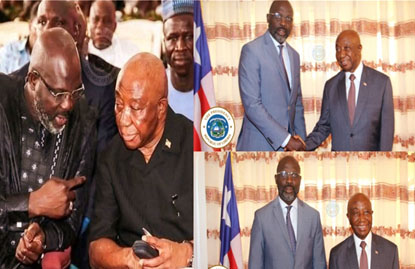
Supporters of the opposition CDC have portrayed Kouyateh’s suggestion as “proof of inefficiency within Pres. Boakai’s administration.”
Ambassador At Large, Sheik Al-Moustapha Kouyateh, has ignited fresh political controversy with a call for President Joseph Nyuma Boakai to personally engage former President George Weah.
Kouyateh described the suggested visit as a necessary step toward national reconciliation.
His remarks, delivered during a radio appearance, have quickly shifted from a reconciliation appeal into a broader political flashpoint.
It has exposed the underlying tensions within the governing Unity Party (UP), and raising questions about internal cohesion at the highest levels of government.
Kouyateh argued that the fragile political climate requires deliberate and symbolic leadership.
He insisted that Pres. Boakai should take the initiative by visiting Weah as a demonstration of “maturity and national responsibility.”
He has maintained that his position is rooted in patriotism, insisting that country progress depends on unity beyond political affiliations.
Such a move, Kouyateh said, would not only calm post-election tensions, but signal a break from entrenched political hostilities that continue to define governance misgivings.
His comments, however, have also drawn sharp criticism, with some political actors interpreting the suggestion as a “subtle challenge to presidential authority and protocol.”
Kouyateh meanwhile, accused individuals within the inner circles of both leaders for “deliberately obstructing communication.” He claimed they are motivated by “self-interest rather than national unity.”
He alleged that the aides benefit politically from division, warning that their influence risks prolonging unnecessary bad blood or friction between the current and former administrations.
Amb. Kouyateh’s blunt accusations have added another layer of controversy, as they indirectly questioned the effectiveness of advisory structures surrounding Boakai and Weah.
Within the Unity Party, reactions have been divided, with some officials privately expressing concern that Kouyateh’s public statements reflect deeper fractures inside the ruling establishment.
Critics have argued that sensitive political engagements, particularly involving a sitting president and his predecessor, should be handled discreetly rather than debated openly in the media.
Others within the ruling party have described the remarks as “ill-timed.”
They suggested that such comment could undermine the image of a unified government at a moment when public confidence remains fragile.
Meanwhile, supporters of the opposition Coalition for Democratic Change, have portrayed the Kouyateh’s suggestion as “proof of inefficiency within the current administration.”