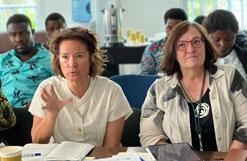
Local and international stakeholders convened at the Delegation of the European Union in Liberia for the presentation of a Political Economy Analysis on inclusion and exclusion in Liberian politics.
The study, conducted by the Ducor Institute for Social and Economic Research under the Liberia Electoral Support Project, was commissioned by the Netherlands Institute for Multiparty Democracy (NIMD).
According to a release, the analysis explores the structural and cultural dynamics that shape political participation in the country, with a focus on women and youth.
Executive Director of the Ducor Institute, Dr. Aaron Weah, who presented the findings, highlighted that decision-making within political parties remains highly centralized, and dominated by senior leaders, limiting opportunities for meaningful engagement by women and young people.
The report, according to the release, reveals that women’s access to leadership is often contingent on family legacy, financial resources, or patronage networks, while youth are typically relegated to campaign support roles with little influence over policy or strategy.
Party structures continue to prioritize seniority, discouraging younger aspirants from contesting leadership positions.
NIMD Country Director, Oscar Bloh, underscored the importance of the study in shaping inclusive democratic interventions.
Bloh: “This analysis helps us understand the power dynamics within political institutions and provides a roadmap for promoting greater inclusion and accountability.”
He said, the findings are already informing NIMD’s Regional Democracy School activities.
Head of the EU Delegation to Liberia, Nona Deprez, praised the research for documenting long-standing challenges.
“While many of these issues are familiar, having them clearly articulated is vital for driving change,” she said.
Second Secretary and Political Officer at the Embassy of Ireland, Kevin Culligan, echoed this sentiment, adding that the report offers both confirmation and deeper insight into known dynamics.
“The detailed findings enrich our understanding and should be widely read,” he said.
The Liberia Electoral Support Project is supported by the EU, Irish Aid, and the Embassy of Sweden.