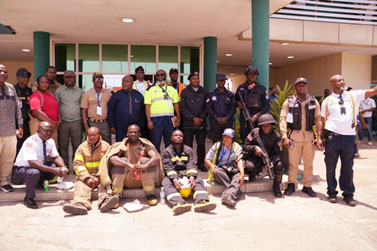
The Liberia Maritime Authority (LiMA), has successfully executed its first-ever nationwide International Ship and Port Facility Security (ISPS) Level 2 exercise.
The high-level exercise was conducted simultaneously in two major port facilities in close partnership with the National Port Authority (NPA), alongside key national security and emergency response agencies.
The initiative reflects continued dedication to the full implementation of the International Ship and Port Facility Security Code, a globally recognized framework designed to safeguard ports and vessels against modern security threats.
Deputy Commissioner for Domestic Vessel Registration and Safety, John F. Harvey, described the exercise as a strategic step to enhance the maritime resilience.
He Harvey said, the nationwide simulation was specifically designed to test the effectiveness of Port Facility Security Plans; improve operational coordination among agencies, and strengthen command, communication and rapid response systems.
He said, the exercise successfully simulated a coordinated national security threat scenario that required port facilities to elevate their security posture from MARSEC Level 1 to Level 2, triggering a robust multi-agency response.
Institutions that participated included the Liberia National Police, Liberia Immigration Service, Liberia Coast Guard, the Liberia Seaport Police, the Liberia Fire Service and the Ministry of Health Ambulance Service.
These agencies swiftly deployed personnel and resources on land and at sea, demonstrating the growing capacity to respond to complex maritime security incidents.
Officials praised the performance of all participating institutions, highlighting the strong collaboration, professionalism and readiness displayed throughout the exercise.
The successful simulation underscored the country’s ability to align national port security systems with international best practices.
Harvey said, the exercise sends a powerful signal of unwavering commitment to maintain world-class maritime security standards, especially amid evolving threats in the Gulf of Guinea.
The exercise also served as a practical validation of the preparedness of port facility personnel, and national enforcement teams in carrying out their respective security responsibilities with precision and confidence.
LiMA meanwhile, announced plans to broaden upcoming exercises by involving terminal operators, shipping companies and additional maritime stakeholders.
This expansion is expected to further reinforce maritime security architecture and deepen stakeholder collaboration in the shipping industry.