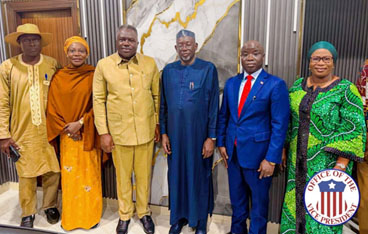
In a major boost to Liberia’s drive toward agricultural transformation and regional economic cooperation, Vice President Jeremiah KpanKoung, on Tuesday, April 7, 2026, hosted a high-level bilateral meeting with Umar Namadi, Executive Governor of Jigawa State in the Federal Republic of Nigeria, during the governor’s official visit to Liberia.
The strategic engagement marks another significant milestone in the strengthening of Liberia–Nigeria relations, with a renewed focus on agricultural modernization, food security, knowledge exchange, and private sector investment.
It also reflected the Government of Liberia’s growing commitment to building strong subnational partnerships across Africa that can deliver practical and measurable development outcomes.
Held in an atmosphere of mutual respect and shared vision, the meeting brought together senior Liberian government officials, representatives of the Nigerian Embassy, development partners, and private sector stakeholders.
At the center of the discussions was the urgent need to unlock new opportunities within Liberia’s rice value chain, which remains one of the country’s most important pillars for food security and economic resilience.
Welcoming the visiting delegation, Vice President Koung described the meeting as timely and highly significant, emphasizing that Liberia’s agriculture sector remains central to the government’s ARREST Agenda for Inclusive Development.
He stressed that the country is determined to move from dependency on imported rice to a future defined by increased domestic production and self-sufficiency.
According to him, Liberia sees Jigawa State’s agricultural success story as a model worthy of adaptation, particularly in the areas of mechanized farming, irrigation expansion, and structured farmer support systems.
He noted that rice remains deeply tied to Liberia’s food security architecture and overall economic stability, making investments in the sector not only necessary but urgent.
The Vice President further highlighted Liberia’s strategic comparative advantages, including vast arable land, favorable climatic conditions, and access to regional trade corridors through the Mano River Union.
These assets, he said, position Liberia as an attractive destination for Nigerian investors, agribusiness firms, and agricultural technology providers seeking to expand their footprint in West Africa.
He encouraged the Jigawa delegation and associated private sector actors to explore Liberia’s emerging opportunities in commercial agriculture, agro-processing, storage infrastructure, and seed multiplication initiatives.
Also speaking during the high-level dialogue, Agriculture Minister, Dr. J. Alexander Nuetah, reaffirmed the government’s commitment to transforming Liberia’s agriculture sector into a modern engine of growth capable of driving jobs, industrial development, and national food sovereignty.
Minister Nuetah noted that Liberia’s food security strategy is inseparable from rice security, making the current engagement particularly relevant to the nation’s development priorities.
He pointed to several ongoing interventions already being pursued by the government, including land development programs, mechanization initiatives, irrigation expansion, improved extension services, and support for value addition across the agricultural supply chain.
According to him, the partnership discussions with Jigawa State offer Liberia an exceptional opportunity to accelerate these reforms by drawing lessons from tested models that have delivered strong results in northern Nigeria.
The minister also emphasized the critical role of Liberia’s smallholder farmers, describing them as the backbone of the country’s agricultural future.
He stressed that expanding access to quality seeds, fertilizer, farm equipment, market systems, and technical support will remain key pillars of the government’s inclusive transformation strategy.
For his part, Governor Namadi praised Liberia’s bold agricultural vision and expressed deep appreciation for the warm hospitality extended to his delegation.
He reaffirmed Jigawa State’s readiness to support Liberia’s agricultural ambitions through technical cooperation, policy dialogue, and experience sharing.
Governor Namadi explained that agriculture remains the backbone of Jigawa State’s economy and has served as a major driver of rural development, job creation, and food production.
He attributed the state’s progress to deliberate leadership decisions, sustained government investment, and consistent empowerment of smallholder farmers.
He highlighted several flagship interventions that have helped Jigawa State boost productivity, including expanded cultivation schemes, improved seed systems, mechanization centers, irrigation infrastructure, and structured farmer support programs.
These initiatives, he noted, have significantly reduced import dependence while improving local livelihoods and strengthening value chains.
The governor expressed optimism that Liberia and Jigawa State can build a strong and mutually beneficial partnership capable of producing real development gains for both sides.
He said the meeting laid the groundwork for a practical framework of sustained bilateral engagement that could soon lead to formal cooperation agreements in agriculture, technical training, and investment facilitation.
Observers said the talks represent a major diplomatic and economic breakthrough, especially as Liberia intensifies efforts to diversify its economy and reduce vulnerability to global food price shocks.
The focus on rice production is particularly significant given Liberia’s long-standing reliance on imports and the increasing pressure to boost local productivity amid rising demand.
Beyond agriculture, the engagement also signals Liberia’s broader strategy of strengthening regional cooperation, attracting credible foreign investment and promoting south-south partnerships that support sustainable development goals.
The Vice President described the meeting as fully aligned with the government’s national agenda to increase productivity, improve livelihoods, and build a more resilient economy.
Officials say the discussions are expected to translate into concrete next steps, including technical exchanges, joint feasibility studies, investment mapping, and the possible signing of a bilateral cooperation framework in the near future.
As Liberia continues to reposition itself as a competitive agricultural hub in the sub-region, Tuesday’s landmark talks with Jigawa State stand as a powerful example of visionary leadership, practical diplomacy, and a shared African commitment to food security and economic progress.
The meeting not only reinforces the growing bonds between Liberia and Nigeria but also sends a strong signal that the future of African development lies in collaboration, innovation and bold partnerships that empower farmers, attract investment, and transform lives.