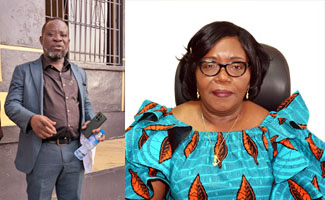
The court has subpoena former Defense Minister Daniel Ziankahn and former Armed Forces of Liberia Chief of Staff, Prince Charles Johnson to testify.
The defense team in the ongoing trial, which involves former Finance Minister Samuel Tweah and others, gained significant ground this week with blemished testimonies from state witnesses.
Testimony from Deputy Finance Minister for Budget Tanneh Brunson, appeared to contradict a central pillar of the case as bystanders burst into earsplitting laughter in courtroom.
On Monday, April 13, defense counsel concluded a strong cross-examination of lead investigator Baba Mohammed Boika, highlighting inconsistencies between his assertions and Brunson’s prior statement to the Liberia Anti-Corruption Commission (LACC).
Boika had relied on Madam Brunson’s earlier statement to suggest that the transaction under investigation, valued over L$1.05 billion and US$500,000 was illegal.
His conclusion was based on Madam Brunson’s observation that the funds were processed through a direct debit, rather than the standard budgetary allotment process, which is the oversight of Deputy Finance Minister for Budget at the Ministry of Finance and Development Planning (MFDP).
However, during cross-examination, defense counsel Arthur Tamba Johnson, pressed Boika to identify where Madam Brunson had explicitly described the transaction as “illegal” in her LACC’s statement.
The witness was unable to respond after the prosecution objected, arguing that “the evidence speaks for itself.”
The court sustained the objection, preventing further response.
On Tuesday’s (April 13) witness stand, Madam Brunson reaffirmed that she was unaware of the transaction at the time, “because it did not pass through the customary allotment process. Instead, such direct debits are typically processed through the Office of the Comptroller and Accounting General with formal requests sent to the Central Bank of Liberia.”
Madam Brunson clarified that while the transaction deviated from standard procedures, it was “technically possible under emergency circumstances.”
She noted that national emergencies, such as the COVID-19 pandemic, can place “urgent demands on government finances, sometimes necessitating direct debits outside normal budgetary channels.”
“The budget is a projection,” she explained, adding that funds are not always readily available, and that government may act swiftly under “fiscal pressure.”
Madam Brunson’s testimony stopped short of labeling the transaction as illegal, directly contradicting the interpretation advanced by investigator Boika.
Legal analysts suggest that Madam Brunson’s clarification weakens prosecution’s argument that all government expenditures must strictly adhere to pre-approved budgetary allotments. This position had already been challenged during earlier proceedings through references to Public Financial Management (PFM) law.
By framing the transaction as procedurally unusual, but not unlawful, her testimony introduces reasonable doubt regarding the alleged illegality.
The prosecution also presented testimony from CBL official Theophilus Lamin, who denied receiving funds on behalf of national security.
However, Lamin’s testimony contained inconsistencies, particularly regarding his acknowledgment of accessing the bank vault.
Meanwhile, Criminal Court ‘C’ has issued writs of subpoena former Defense Minister Daniel Ziankahn, and former Chief of Staff, Prince Charles Johnson to testify.