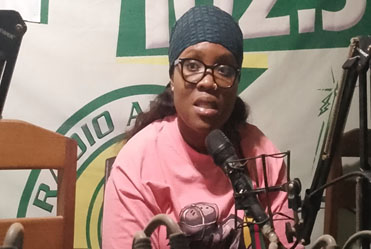
Youth and Sports Minister Cornelia Wonkerleh Kruah on Thursday, April 9, announced plans to install the first-ever artificial turf pitch in Grand Kru County.
The pronouncement quickly stirred political debate over the county’s long-standing lack of sports infrastructure despite being the home of former President George Weah.
While speaking on the Ahteenah Radio Morning Platform on April 9, Minister Kruah said, the project is part of government’s broader effort to close infrastructure gaps in the 15 counties, and strengthen youth development through sports.
The announcement comes as Grand Kru prepares to host activities for the 2026–2027 National County Sports Meet. The expected development has meanwhile, increased pressure on authorities to upgrade sporting facilities in the Southeast.
Kruah said, Grand Kru’s absence of a standard playing field has remained a major concern, particularly given the county’s symbolic connection to Weah, Africa’s only Ballon d’Or winner.
“This is about giving our young people the opportunity they deserve. The Ministry of Youth and Sports remains committed to expand access to quality sports facilities nationwide.”
Kru’s statement has already generated discussion in political and sports circles, with some observers pointing to the irony that the birthplace of one of Africa’s most celebrated football figures has for years lacked a modern sports facility.
Critics argue through telephone conversations that the development raises fresh questions about the record of previous administrations, especially during Weah’s presidency, when expectations for sports infrastructure were high because of his football legacy.
Minister Kruah, who is currently undertaking the second phase of a nationwide county tour said, consultations with communities brought gaps in youth and sports infrastructure, particularly in underserved counties.
The Grand Kru turf project is among several planned interventions to boost grassroots sports and create better opportunities for young athletes.
Residents and local sports enthusiasts have welcomed the announcement. They described it as a timely intervention ahead of the National Sports County Meet.
Editorial
Let Gov’t Check Deeper in Bea Mountain’ Suitcase
Over the weekend, Vice President Jeremiah Kpan Koung made an emergency visit to the Bea Mountain, a gold mining company located in Grand Cape County where the delegation discovered that the company sells billion dollars’ worth of gold annually, while Liberia gets nothing significant in royalty.
During his visit, one of the most striking issues was the scale of gold production compared to what Liberia is gaining. The company reportedly produces around 900 kilograms of gold per month.
This translates into huge revenue (running into hundreds of millions or more annually, indicating that Liberia’s share of this wealth appears very small.
Local communities remain poor despite rich mineral extraction with limited local benefits; environmental damage and poor living conditions.
The vice president reportedly discovered massive gold production, huge company revenues, relatively low national and community benefit.
VP Koung’s visit revealed a troubling imbalance that Liberia is rich in gold at Bea Mountain, but many Liberians are not seeing the full benefits of that wealth.
The reality is that citizens have natural rights over all God-given resources including golds, silvers, diamonds, oil, amongst others.
In God’s wisdom, these resources are meant to make the country and its citizens wealthy, healthy joyful and gleeful as a nation and people.
In God’s wisdom, no citizen should sit sad, go mad under the weight of abject poverty as it currently the situation.
The government should now begin to turn things around, and set the pace for prosperity to grow and touch the lives of all citizens.
While in poverty, a given nation and people know no peace and stability, something which is counterproductive to the wisdom of God.
Liberia has iron ore, gold, timber, rubber, and more. But much of this wealth is controlled by foreign companies, or a small group of elites.
The revenue generated does not often trickle down to ordinary citizens in the form of jobs, infrastructure, or services.
From the early days of the country, power was concentrated in the hands of a few. This created a system where opportunities were not equally shared, and that legacy still affects the country today.
When leaders misuse public funds or prioritize personal gain, national development suffers. Money that could build schools, hospitals, and roads is sometimes diverted or poorly managed.
Liberia’s civil wars (1989–2003) destroyed infrastructure, displaced people, and weakened institutions. Even years later, the country is still rebuilding from that damage.
The economy relies heavily on raw materials. There’s limited industrialization, so Liberia exports raw resources, but imports expensive finished goods. This keeps the country from maximizing its wealth.
Many young people lack access to quality education and jobs. Without employment, even a resource-rich country can have widespread poverty.
Systems that ensure accountability, fair distribution, and development are still developing. Without strong institutions, wealth can be mismanaged.