By Godgift Harris
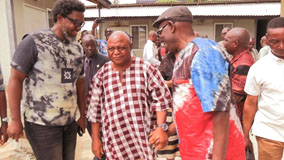
The nomination of Jonathan Weedor as acting chairperson of the National Elections Commission (NEC) is already drawing scrutiny.
As such, the Center for Transparency and Accountability in Liberia (CENTAL), has warned that questions over Weedor’s political independence could threaten public trust in the electoral system.
CENTAL Executive Director Anderson D. Miamen, said while Weedor’s technical credentials, and long record in electoral governance are widely acknowledged, the more pressing issue is whether he can convincingly demonstrate the neutrality required to lead one of the most sensitive democratic institutions.
Miamen made it clear that “competence alone is not enough to chair the Commission, but neutrality.”
He however acknowledged, Weedor’s professional experience in elections management, both internally and internationally, places his qualifications beyond dispute.
Yet, Miamen said, independence, credibility and public perception, remain the true tests of fitness for the NEC chairmanship, particularly at a time when the democratic stability depends heavily on confidence in the electoral process.
He pointed to a widely circulated social media video that allegedly links Weedor to the ruling Unity Party, a development he warned, could severely damage perceptions of neutrality.
Miamen argued that even the appearance of partisan loyalty is enough to weaken citizens’ confidence in the Commission ability to fairly arbitrate future elections, especially in a political climate where trust in state institutions remains fragile.
CENTAL has repeatedly said, governance institutions must be led by individuals whose impartiality is not open to public doubt.
Miamen further questioned the logic behind the nomination process itself, insisting that the country has several equally qualified professionals, whose records of independence are clearer and less controversial.
In his view, the administration’s decision risks reopening old national wounds over the politicization of electoral bodies.
In a pointed dismissal of attempts to justify the nomination by citing precedents under former President George Weah, Miamen warned that repeating questionable past practices cannot serve as a legitimate defense for present-day decisions.
“Past mistakes should not become the standard for current governance,” the criticism suggests, underscoring a broader frustration within civil society over what many see as a pattern of politically convenient appointments.
CENTAL also challenged the reliance on provisions of election law that allow commissioners to resign from political affiliations upon appointment.
Miamen argued that such legal safeguards, while important, should never replace the more fundamental principle of selecting candidates whose independence is already well established before nomination.
Latest Development:
In a latest development, Mr. Weedor has officially taken over NEC as Davidetta Browne Lansanah bid farewell.
Madam Lansanah formally hands over to Mr. Weedor as Acting chair of the Commission.
The handover ceremony on Wednesday, April 1, marks a significant transition at the Electoral Management Body (EMB) while speaking of continuity and institutional stability.
At a brief turnover ceremony held at NEC headquarters, Madam Lansanah welcomed Mr. Weedor and his team, presenting an official turnover note that included a financial report and key institutional updates.
She said, a General Auditing Commission (GAC) audit had been successfully conducted as part of accountability measures during her tenure.
Madam Lansanah meanwhile, expressed gratitude to the President for the opportunity to serve, and extended appreciation to NEC Secretariat and staff, her family, and the Liberian people for their support throughout her time in office.
Mr. Weedor described his return to the Commission as a ‘homecoming. ‘ he too expressed appreciation for the leadership of his predecessor, and the Commission’s management team.
He called for continued cooperation from both the leadership and staff, adding that his mandate is to serve in the interest of the country, not an individual or any particular political party.