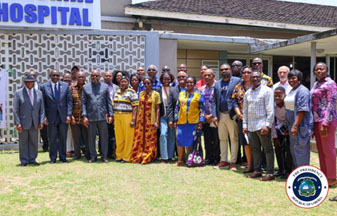
President Joseph Nyuma Boakai has officially launched a new Ear and Hearing Care Project at the John F. Kennedy Medical Center, marking what government officials have described as a major step toward improving specialized healthcare services in Liberia.
Yet, even as the initiative was celebrated, concerns from patients over persistent medicine shortages at the hospital have cast a critical spotlight on the broader state of service delivery at JFK.
The project, unveiled over the weekend in Monrovia, is a partnership involving the Rotary Club of Monrovia, Church Aid Incorporated, and the Ministry of Health.
The donated equipment, procured through Rotary International after consultations led by Church Aid, is intended primarily to support children and other Liberians living with hearing impairments.
At the launch, President Boakai praised the initiative as an important intervention in a healthcare system still struggling with infrastructure gaps, limited diagnostic tools, and unequal access to specialist services.
“These are important contributions,” the President said, stressing that the government remains committed to improving healthcare delivery nationwide.
He also commended health workers at JFK for their sacrifice and dedication, while admitting that the hospital still faces serious operational challenges.
The President’s remarks acknowledged a reality many Liberians know too well: while improvements may be visible, the healthcare sector remains under intense pressure.
The Rotary Club’s president, Rtn. G. GbassayGolee, described the project as part of the organization’s commitment to impactful community service.
He emphasized that the equipment will also benefit facilities in Lofa, Bong, and Bomi Counties, broadening access beyond Monrovia.
However, Golee’s emphasis on sustainability and accountability appeared especially relevant; given longstanding public concerns over how medical resources are managed in government institutions.
“Of great importance to us is the sustainability of this project after it is handed over,” he said, noting that the Rotary Club intends to monitor its use and demand measurable outcomes.
Medical experts said the intervention is timely. ENT Consultant Dr. Tabeh L. Freeman warned that hearing loss is becoming a growing public health crisis, both globally and locally.
According to him, about 20 percent of the world’s population is affected by some form of hearing impairment, while Liberia continues to face an urgent shortage of modern screening and treatment equipment.
Dr. Freeman revealed that JFK has treated at least 3,000 patients since ENT services were restored, with nearly 60 percent of cases linked to ear and hearing complications.
Yet, the optimism surrounding the launch was tempered by troubling complaints from patients at the JFK center.
Several patients reportedly said they are still being directed to purchase prescribed drugs from Lucky Pharmacy, located opposite the hospital, because the medicines are unavailable within JFK.
The practice has raised serious questions about the hospital’s internal drug supply chain and procurement system.
Patients claimed doctors and nurses often write prescriptions on paper and instruct them to take the notes outside the hospital to buy medications.
These complaints have now triggered public concern over whether there is a formal referral arrangement between JFK and the private pharmacy, or whether the recurring practice simply reflects chronic stock shortages.
More critically, some patients are asking whether healthcare workers may be benefiting from the repeated external referrals an allegation that underscores the urgent need for transparency, oversight, and an official response from hospital management.
While no evidence has yet been presented to support claims of improper financial benefit, the perception alone risks undermining public confidence in the country’s premier referral hospital.
As Liberia celebrates progress in hearing care, the lingering medicine access problem at JFK serves as a stark reminder that healthcare reform must go beyond equipment donations.
For many patients, the true test of progress lies not in ceremonies, but in whether they can receive complete treatment inside the hospital without being forced into costly outside purchases.