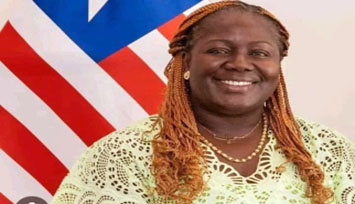
The Assets Recovery and Property Retrieval Task Force (AREPT) has announced the indictment of former Commerce Minister Mawine G. Diggs and six others over the alleged theft and diversion of more than US$1.8 million in public funds intended to support vulnerable rural women and small businesses.
The latest indictment was unveiled Thursday, April 9, 2026, by AREPT Chairperson, Cllr. Edwin Kla Martin at the Ministry of Information regular press briefing.
This development has sent a strong signal that the government’s recovery campaign is widening its net to include former senior officials and civil society-linked actors accused of abusing public trust.
Cllr. Martin disclosed that Criminal Court “C” has formally indicted seven individuals on serious charges including Economic Sabotage, Theft of Property, Misuse of Public Money, Misapplication of Entrusted Property and Criminal Conspiracy.
Those named in the indictment include former Minister Diggs, Financial Comptroller Gudi J. N. Neufville, former Senior Policy Advisor Joseph Yado Howe and Kebeh Monger.
The President of the Liberia Marketing Association, Elizabeth Finda Sambulah, Josephine Handful Greens, former Secretary General of the National Rural Women Structure of Liberia, and Kemmoh Borbor, cashier at the Ministry of Commerce and Industry were also linked.
At the heart of the case is the 2023 “Vulnerable Small Business Support Program,” a government-backed initiative designed to empower rural women, farmers, petty traders, and struggling entrepreneurs through the Rural Women Empowerment Fund.
Investigators said the Government of Liberia allocated US$2 million to the Ministry of Commerce and Industry for the initiative, of which US$1,819,469.43 was reportedly disbursed and deposited into Central Bank-managed accounts under the control of senior ministry officials.
However, rather than reaching the women and grassroots entrepreneurs for whom the money was intended, AREPT alleged that the funds were deliberately diverted into private use, stripping thousands of intended beneficiaries of a crucial economic lifeline at a time when many Liberians were battling post-pandemic hardship, inflation, and limited access to credit.
This allegation has made the case particularly disturbing because it goes beyond ordinary financial misconduct.
It touches directly on the exploitation of one of Liberia’s most vulnerable populations of rural women whose economic survival often depends on small grants and revolving support programs.
Cllr. Martin pushed back strongly against suggestions that the indictments are politically motivated, insisting that the Task Force’s months of relative silence should be seen as evidence of painstaking investigative diligence rather than hesitation.
He stressed that AREPT has spent months conducting what he described as a “thorough and systematic analysis” of documentary and financial evidence.
“There will be no witch-hunt,” Martin declared, emphasizing that every indictment is based on tangible evidence and due process, with all accused persons having been invited to participate in the investigation alongside legal counsel in keeping with Article 20(a) of the 1986 Constitution.
The case marks AREPT’s fourth major indictment since its establishment under Executive Order No. 126 by President Joseph Nyuma Boakai in March 2026, underscoring the administration’s growing emphasis on asset recovery and accountability.
Yet, beyond the courtroom drama, the scandal raises deeper national concerns about how corruption continues to sabotage social protection programs meant for ordinary citizens.
For many observers, the alleged looting of a rural women’s support fund is especially symbolic of the systemic failures that have long undermined public confidence in governance.
Martin concluded with a stern warning that the government will not stop at domestic prosecutions, vowing to pursue all stolen assets both locally and internationally.
As Liberia watches the case unfolds, the indictments now place fresh pressure on the justice system to prove that high-profile corruption prosecutions can move beyond headlines and deliver convictions, restitution and real deterrence.
The real test, many believe, will not only be whether the accused are punished, but whether the stolen money can ultimately be restored to the rural women and small businesses, who were allegedly robbed of opportunity.