By Godgift Harris
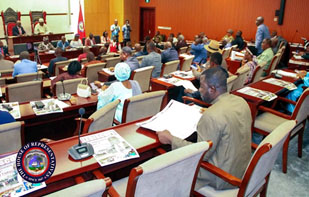
Members of the House of Representatives (HoR) are facing yet, one of its most serious internal crises in recent years as at least 48 lawmakers have reportedly endorsed resolutions to remove Speaker Richard Nagbe Koon.
The opposing lawmakers have cited grave “ethical and moral” allegations they argue have irreparably damaged the credibility of the legislature.
Multiple legislative sources confirmed that the lawmakers have withdrawn political support from Speaker Koon following allegations that included incest and fraud linked to the acquisition of a United States permanent residency card.
Though, the accusations have not been tested in a court of law, critics within the House contended that the seriousness of the claims alone is enough to render Koon unfit to continue presiding over what is constitutionally the First Branch of Government.
The move marks a dramatic escalation of tensions within the House, exposing deep divisions over leadership, ethics, and accountability at a time when public confidence in state institutions remains fragile.
According to lawmakers backing the resolutions, Koon’s office demands unimpeachable moral standing and transparency standards, they say have been gravely undermined by the allegations now surrounding the Speaker.
They argue that continued silence or inaction risks dragging the entire legislature into public disrepute.
“The issue is not whether the allegations have been proven in court,” one lawmaker, speaking anonymously told this newspaper.
“It is about whether the House can continue to function credibly under a Speaker facing accusations of this magnitude. The institution itself is at risk.”
Beyond the allegations, critics accused Speaker Koon of weak leadership and presiding over a fractured House.
They claim legislative cohesion has deteriorated under his stewardship, resulting in growing mistrust among lawmakers, and an erosion of the authority of the Speaker’s office.
Several representatives have warned that the controversy has already tarnished the image of the Legislature, both domestically and internationally, reinforcing public perceptions of ethical decay at the highest levels of governance.
Civil society actors and political observers, have echoed those concerns, arguing that the House’s response to the crisis will be a critical test of country’s commitment to accountability.
Sources familiar with the removal effort say the lawmakers intend to make public the full list of signatories in the coming days, signaling a determination to proceed despite anticipated political retaliation.
The disclosure, if carried out, could further harden positions within the House, and intensify the struggle for control of its leadership.
Supporters of the move described the effort as part of a broader reckoning over standards of conduct in public office.
They insisted the campaign is not driven by “personal vendettas,” but by the need to restore public trust in a Legislature increasingly viewed as detached from ethical responsibility.
However, significant constitutional and procedural hurdles remain.
It is still unclear whether the removal bid will meet the thresholds required under House rules and the Constitution to unseat a sitting Speaker.
Legal experts note that any misstep could plunge the Legislature into prolonged institutional paralysis or trigger court challenges.
The embattled Koon has so far not issued a formal public response to either of the allegations, or the reported resolutions seeking his removal.
Repeated attempts by this newspaper to obtain comment from his office were unsuccessful, further fueling criticism that the Speaker has failed to address a crisis threatening the integrity of the House.
The unfolding drama has also sparked speculation about whether President Joseph Nyuma Boakai could be drawn into the dispute, especially given his administration’s stated emphasis on accountability and integrity in public service.
For now, the House stands at a crossroads caught between due process and public pressure, political loyalty and institutional integrity while the credibility of its leadership hangs in the balance.