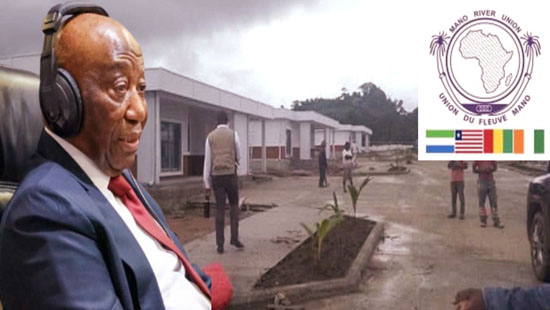
President Joseph Nyuma Boakai in the second year of his administration has showcased the ambition of erecting a gigantic infrastructure in his home district Foyah in Lofa County as a Mano River Union Center for Regional Peace and Development for Sierra Leone, Guinea, Ivory Coast and Liberia.
However, where the sources of funding for the project that reportedly costs Millions of United States Dollars come from have sparked public debate amongst Liberians, particularly those from the governing Unity Party and the opposition community.
The project’s location being at the Liberia-Sierra Leone border in Foyah, President Boaki’s home has also cast skepticism as to the intent of placing the infrastructure in the area, coupled with the secret nature of the project up to the time of speculations and revelations tied to the Liberian government’s initiative.
Recollecting experience from past regimes, specifically the epochs of William V.S. Tubman, Samuel K. Doe and other past presidents of Liberia, critics have surmised that huge infrastructures erected by those in power and sometimes named in their honor can end up becoming financial burdens to the state, and as one critic said: “This is a white elephant project.”
The critic noted: “A white elephant project is a costly undertaking, like a building or infrastructure that becomes a financial burden due to its high upkeep, lack of utility, or failure to meet expectations, draining resources without providing equivalent value, stemming from an old Southeast Asian tradition where rare, sacred white elephants were costly gifts. These projects are often marked by poor planning, low demand, or technical failures, becoming massive, hard-to-sell assets that offer little benefit.”
Some critics have referenced the abandoned Tubman Farm in Totota, Bong County, as well as the huge unfinished infrastructure Doe erected in Tuzon, his hometown in Grand Gedeh County.
However, as concerns mount over the real rationale behind the now controversial project ongoing in Foyah,
Deputy Information Minister Daniel O. Sando writes: “Here is everything you need to know about the MRU Presidential Project for Regional Peace and Development:
The Project:
The project is a Government of Liberia initiative, and it’s named “The Mano River Union Center for Regional Peace and Development”. It is not private property, as some political actors and media outlets have insinuated.
It is a strategic asset specifically designed to host sub-regional, regional, and global high-level gatherings, meetings, talks, and conferences focused on mediation, conflict resolution, and economic integration.
It includes a 500-seat conference hall and secure accommodations in nine units for visiting dignitaries. It is situated on approximately 7 acres of land in Foya, Lofa County.
Why the Project:
Liberia is the oldest independent nation in the Mano River Basin, which consists of four countries. Liberia is respected as a regional leader and is looked to for guidance on key issues, including regional peace and security. The center offers a secure and strategic space to host national, global, and presidential dialogues when Liberia needs to do so.
Liberia’s current role on the United Nations Security Council over the next couple of years, as well as its esteemed and respected standing on the sub-regional, regional, continental, and global stage, requires it to be well prepared to support and lead regional dialogues on peace and security beyond the MRU Region. The facility under and within the project would be a significant and strategic enhancement to the country’s current roles.
Why Foya, Lofa County?
Foya District is a strategic location in the northern part of Lofa, situated at the confluence of Liberia, Sierra Leone, and Guinea, the three founding members of the Mano River Union. Its distance from the bustling suburban areas of Lofa and other parts of Liberia makes it an ideal geographic hub for cross-border security and conflict and peace discussions. The people of Foya have long been active in dialogues with their neighbors in Sierra Leone and Guinea on regional peace and development issues – through the Makona River Organization.
The Government of Liberia sees this initiative as a project for the MRU Region to promote peace, security, and cross-border collaboration at different levels.
Why the Confidentiality:
The project’s confidentiality was strictly governed by security protocols necessary for constructing facilities with security implications, intended to host high-level officials and events requiring high security and sensitivity. It is unconventional to publish or discuss the blueprints and security layout of a facility designed to host regional and global leaders, VIPs, and other dignitaries while it is under construction; this helps prevent security vulnerabilities.
The unauthorized drone footage that sparked debate about the project posed a risk to the security and integrity of the project and proves the point being made.
As mentioned earlier, the facility is not private property at all, but public property owned by the Government of Liberia, with national, regional, and global implications.
Funding of the Project:
The project is financed through a combination of contributions from national, regional, and global entities, as well as private individuals and businesses. The total investment is estimated at approximately $6.1 million.
The President, government officials, and senior security officials will visit the project site this December as part of his inspection of national development projects.
Regional Launch:
The regional launch of the project will be scheduled after its full completion in 2026. It is anticipated that both national and regional stakeholders will participate. This project affirms Liberia’s role as a peacemaker in the West African region.”
Yet, President Boakai’s latest ELBC panelist discussion appears to have created more questions than answers to the public curiosity directed at the project in Foyah.
The President is quoted as claiming that he was not in the know of the project from its genesis, clarifying that it is not the priority of Liberia now.