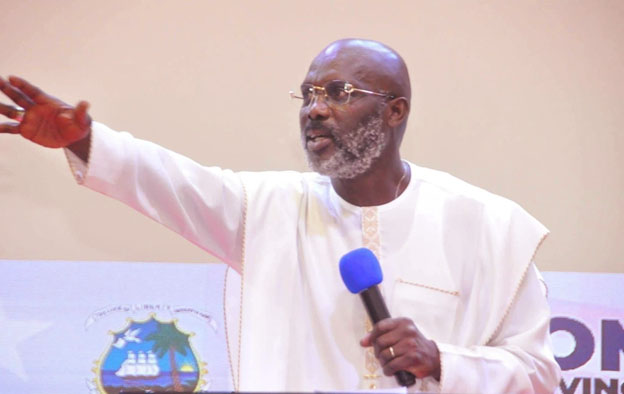
For President George Weah has warned his perceived detractors or critics of his regime (2018-2024) not to swear at the count of his name.
“Do not swear yourself for me. Everybody that says, he can’t be this, he can’t be that, if it happens, let me die, those people have died.”
Weah told a congregation over the weekend that “some people swear! if George Weah becomes this, let me die. Some of those people have died and gone to the great beyond. It shouldn’t be you. Be objective, be positive and be able to hold an up-building conversation.”
He cautioned people against swearing that he will not return to power, maybe in 2028 or any subsequent elections…
He meanwhile, issued a renewed call for peace, tolerance, and national unity.
Weah warned that political hostility and social division threaten the fragile stability the country has worked for more than two decades to rebuild.
He spoke at the Forkay Klon Jlaleh Family Fellowship Center over the weekend, urging Liberians across political, ethnic, and religious lines, to prioritize peace above personal ambition and partisan rivalry.
“Let us avoid anything that will destroy our country. It does not matter who wants to be what. All we need is peace and prosperity,” Weah told the gathering.
Weah, who served as president from 2018 to 2024, described peace as the bedrock upon which development, leadership renewal, and national reconciliation must rest.
“We need peace for future leaders to grow. We need peace to build our country.”
While drawing on his personal journey, Weah reflected on adversity both on and off the football field.
He recalled a career-threatening injury during his professional playing days in Europe.
“They said I broke my leg and would never play again. But I told the child who was crying, they are not God. I recovered and went on to win many accolades,” he recounted.
In a pointed message to supporters and critics, Weah cautioned against political fanaticism, insults and personal attacks, which he said, only deepen divisions and weaken democratic discourse.
“Some people swore their lives on my name. Others did the same, and they died. Be positive. Be objective. Hold conversations.”
He stressed that democracy thrives on persuasion and dialogue, not hostility.
“Fighting and insults will not help the process. That is not the best way forward for our country,” he added.
Political analysts note that Liberia, like many post-conflict societies, remains vulnerable to polarized politics, particularly during transitions of power.
While also invoking biblical teachings, Weah likened Liberia’s political tensions to moments in scripture where patience and explanation prevailed over retaliation.
“Every time Jesus was attacked; He took His time to explain details to his accusers.”
Weah also highlighted Liberia’s deeply interconnected social fabric, noting his own family ties across multiple counties.
“I have uncles from Lofa, aunties, sisters, relatives from everywhere. We are one family in a small country.”
His message called for unity over division.
“Let us not allow politics to divide us. We are one people.”
Weah’s remarks come at a critical moment as the country seeks to consolidate democratic gains, attract investment, and strengthen national reconciliation.
With a population of just over 5 million, the stakes remain high in a nation where political instability has historically carried devastating consequences.
As Liberia charts its future, voices calling for restraint, dialogue, and peace, especially from former leaders may play a crucial role in shaping the next chapter.
Refer and earn up to 50% commission—join now!