By: Godgift Harris
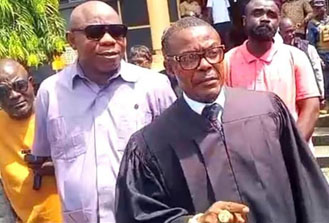
The opening of proceedings at Criminal Court ‘C’ against former Finance Minister Samuel Tweah and four other former government officials has once again placed Liberia’s long-standing struggle against corruption under a national spotlight.
The case, which has begun with the selection of jurors nine already selected with six more pending centers on serious allegations of corruption, economic sabotage, and misuse of public resources during Tweah’s tenure in government.
Prosecutors argue that the accused officials abused their authority and violated public trust in the management of state resources.
However, the defense team, led by Cllr. Arthur Johnson, has put forward a significant argument.
According to the defense, the actions being questioned were taken under statutory authority granted by the National Security Council through the Office of the President.
The defense maintains that the decisions were linked to protecting national security and maintaining peace during a period of political uncertainty.
Yet for many Liberians, the argument of national security has not quieted public concerns.
Across the country, citizens continue to express frustration with what they see as a recurring pattern of corruption allegations involving both past and present government officials.
While the court proceedings focus on Samuel Tweah and his co-defendants, the broader implications of the case reach far beyond the individuals standing trial.
Liberia has spent decades attempting to build a governance system rooted in transparency and accountability.
Yet corruption scandals involving public officials both past and present continue to challenge public confidence in the nation’s institutions.
The charges of economic sabotage are particularly serious under Liberian law.
Such accusations suggest actions that could undermine the country’s financial stability or cause significant harm to national economic interests.
For critics of the former administration, the trial is seen as a critical test of whether Liberia’s justice system can hold powerful political figures accountable.
The Defense Strategy
During the early stages of the proceedings, Cllr. Arthur Johnson presented a defense centered on executive authority.
He argued that the financial decisions in question were not personal actions taken by Samuel Tweah or his colleagues, but rather measures approved by the National Security Council through the presidency.
According to the defense, the decisions were part of broader government efforts to maintain stability and peace during sensitive political moments.
The defense insists that when national security institutions authorize financial measures, government officials implementing those directives should not later be accused of criminal wrongdoing.
This argument has already sparked debate within legal and political circles in Monrovia.
Some legal experts argue that if the decisions were formally approved by the National Security Council, the defense may have grounds to challenge the criminal charges.
Others counter that executive authorization does not necessarily shield officials from accountability if public funds were misused.
Public opinion and the demand for accountability, among ordinary Liberians, however, the debate often returns to a simple question, who takes responsibility when public money disappears?
Many citizens believe that corruption has been one of the greatest obstacles to Liberia’s development since the end of the civil war.
In markets, university campuses, and political discussions across Monrovia and beyond, frustration is growing over what some describe as a culture of impunity.
For these citizens, the case against Samuel Tweah is not just about one administration. It is about whether Liberia can finally establish a consistent standard of accountability for public officials past and present.
“If you steal public money, you must answer to the law,” said a civil society activist during a public forum discussing the case.
“Whether you served ten years ago or you are serving today, corruption must have consequences.”
The role of the Anti-Corruption Commission, the case also raises questions about the effectiveness of Liberia’s anti-corruption institutions, particularly the Liberia Anti-Corruption Commission.
The commission has been responsible for investigating numerous corruption allegations over the years, including cases involving senior government officials.
However, critics often argue that investigations alone are not enough.
Many Liberians believe the commission’s actions to clear certain officials both former and current have sometimes left the public dissatisfied.
Critics say the perception that high-ranking officials can escape accountability undermines confidence in anti-corruption efforts.
“Investigations that end without clear explanations only deepen suspicion,” said a governance advocate.
“Liberians want to see the full truth, not partial conclusions.”
The controversy surrounding Samuel Tweah is not an isolated incident in Liberia’s political history.
The administrations, allegations of corruption have frequently surfaced involving senior government officials.
These accusations have ranged from mismanagement of public funds to abuse of authority in the awarding of government contracts.
Such patterns have fueled growing public demand for stronger institutional oversight and a justice system capable of prosecuting corruption regardless of political influence.
Observers note that Liberia’s democratic progress depends heavily on whether its institutions can treat corruption cases fairly and transparently.
If the public begins to believe that prosecutions are selective or politically motivated, trust in the justice system could erode further.
Legal experts emphasize that while public frustration with corruption is understandable, the court must carefully follow due process.
The trial at Criminal Court C will likely involve complex legal arguments, documentary evidence, and testimony from government officials and financial experts.
The jury’s responsibility will be to evaluate the evidence presented by both the prosecution and the defense before reaching a verdict.
In a functioning democracy, due process is essential not only for protecting the rights of the accused but also for ensuring that justice is credible and legitimate.
For Liberia’s justice system, the Tweah trial may become a defining moment.
If prosecutors succeed in proving their case, it could signal a new era in which powerful public officials are no longer beyond the reach of the law.
If the defense successfully demonstrates that the actions were authorized and lawful, the case could highlight the need for clearer legal frameworks governing emergency financial decisions by the executive branch.
Either outcome will have significant implications for governance and accountability in Liberia.
The Broader Anti-Corruption Challenge, the fight against corruption in Liberia has long been supported by international partners, civil society organizations, and reform-minded government officials.
Yet meaningful progress requires consistent enforcement of laws and institutions that operate independently of political pressure.
Liberia’s experience shows that anti-corruption efforts cannot rely solely on investigations or public statements.
They require strong courts, transparent financial systems, and a culture of accountability across all levels of government.
Without these elements, corruption can continue to undermine development, discourage investment, and weaken democratic institutions.
Past and present officials under scrutiny, the ongoing trial also reinforces a growing public belief that accountability should not be limited to any single administration.
Many Liberians argue that corruption allegations involving past officials must be investigated just as seriously as those involving current officeholders.
This principle reflects a broader demand for fairness and consistency in the application of the law.
Selective justice, critics warn, risks turning anti-corruption campaigns into political tools rather than genuine reform efforts.
For Liberia to build lasting public trust, investigations and prosecutions must be based on evidence and legal standards rather than political considerations.
As jury selection continues and the trial moves forward, the nation will be watching closely.
For citizens who have long demanded greater accountability from their leaders, the proceedings at Criminal Court C represent more than a legal dispute.
They represent a test of whether Liberia’s institutions are capable of confronting corruption at the highest levels of government.
The outcome will likely influence public perceptions of governance, justice, and political leadership for years to come.
Regardless of the verdict, the case has already reignited an important national conversation about responsibility, transparency, and the rule of law.
In the eyes of many Liberians, the central message remains clear: public service must never become an opportunity for personal enrichment.
Whether officials served yesterday or are serving today, accountability must remain the cornerstone of democratic governance.
Only through consistent enforcement of the law can Liberia move closer to a future where public resources truly serve the interests of the people rather than the ambitions of the powerful.