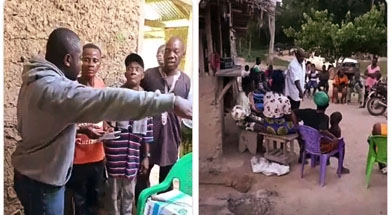
Several remote communities along the Liberian-Ivorian border are accessing the internet for the first time after a Starlink-powered initiative launched over the weekend, bringing satellite connectivity to one of Liberia’s most isolated regions.
Residents of Youbor, Leopard-Town, and Solobloh in Glarro administrative district welcomed what many called a “historic technological breakthrough” as internet equipment was installed in their towns.
Glarro is one of 10 districts in River Gee County, located in the eastern region and bordering Grand Gedeh County. The district faces severe transportation and infrastructure hurdles due to its geography.
Much of Glarro is surrounded by the Cavalla River, which forms a natural boundary with Ivory Coast, making road access extremely difficult. Reaching most major towns requires crossing the Dugbeh River, while Production Camp, Free-Town, and Sackor are accessible only via a severely deteriorated road network.
According to the 2022 Liberia National Population and Housing Census, Glarro has 4,470 residents — 2,485 males and 1,985 females.
Local sources report the connectivity project is being spearheaded by River Gee County Senator and Chairman of the River Gee County Legislative Caucus, Jonathan BoycharlesSogbie, as part of efforts to improve digital inclusion and modern communication infrastructure across the county. The service is powered by Starlink, SpaceX’s satellite internet network, which delivers high-speed, low-latency internet to underserved and hard-to-reach areas where traditional broadband is limited or unavailable.
Community members in the live broadcasts thanked Senator Sogbie for the initiative and pledged to protect and maintain the equipment.
“It will help us communicate with our children both at home and abroad, and also allow us to stay informed about developments in our country and county,” one youth from the district said.
Residents believe the new connectivity could expand opportunities for education, business growth, and integration with the rest of Liberia and the world, despite ongoing road challenges.
It remains unclear whether the project followed a formal community request or was introduced as a voluntary intervention.
The development is being hailed as a major step toward bridging the digital divide in some of Liberia’s most isolated border communities, where road access remains a longstanding barrier.