By Emmanuel Koffa
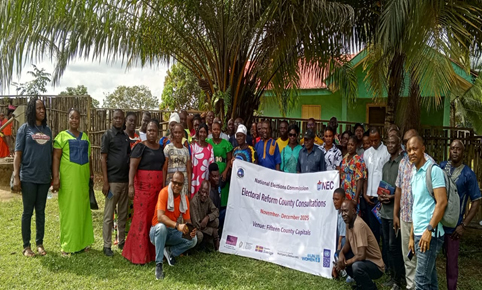
At least 40 stakeholders, including women leaders, traditional chiefs, district commissioners, civil society representatives, youth leaders, and members of the media, have benefited from a daylong County-to-County Consultation on Electoral Law Reform.
The exercise was held in Barclayville, Grand Kru County.
The consultation is part of the National Elections Commission (NEC) nationwide engagement.
It aimed at strengthening electoral framework through inclusive and participatory dialogue.
The County-to-County Consultation on Electoral Law Reform seeks to solicit public input that will help reinforce electoral framework, ensuring fair, transparent, and credible elections.
NEC Deputy Executive Director, Ignatius Wesseh, said the consultations are designed to gather views, and inputs from stakeholders on electoral laws that will guide the Commission ahead of the 2029 elections.
Wesseh expressed optimism that the consultations would yield meaningful results, leading to a better understanding and review of existing electoral laws.
He said the initiative, supported by the UNDP Electoral Project with funding from the European Union (EU) and the government, represents a vital partnership between the NEC and its diverse electoral stakeholders.
“Liberia continues to stand as a leading example of how elections are conducted in the region. This process offers a unique opportunity for all Liberians voters, political aspirants and candidates to contribute by shaping the next phase of the electoral laws,” Wesseh said.
He then challenged participants to critically assess current electoral laws, identify challenge and propose practical reforms that could enhance electoral system, and democratic governance.
Grand Kru County Election Senior Magistrate Stanislaus Wesseh, said the Commission is mandated to conduct elections in accordance with the law.
Wesseh spoke of the stakeholder’s engagements as being essential, adding: “Election is everybody’s business.”
He underscored the need for the Commission to remain closely connected with the people.
Wesseh commended the participants for their active involvement. He described the process as a critical step to address electoral challenges ahead of future polls.
United Nations Development Program (UNDP) representative, Roosevelt Zayzay, lauded participants for their active engagement.
Zayzay reaffirmed UNDP’s commitment to support the NEC and the government in addressing electoral challenges.
Several of the participants, including Edith Jarteh of the Rural Women’s structure, Tatus Gray, Relieving Commissioner, Comfort Doe of Civil Society, and Christopher Menneh, a student representative, called for improvement in the electoral process.
They praised NEC for directly engaging citizens at the grassroots level, and highlighted that public participation in electoral reform is crucial for strengthening democracy and building trust in the electoral system.