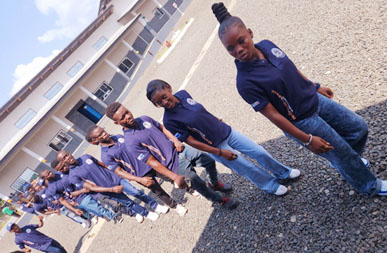
The determination of young Liberians to secure livelihoods through skills training was on full display as the Gateway Vocational Training Center (GVTC) graduated its second batch of trainees—an achievement that signals hope, even as the institution faces a looming financial threat that could derail its mission.
Founded through collaboration between the European Union, the Government of Germany, and implemented by GIZ under the “Capacity Development in the Transport Sector (CDTS)” project, GVTC has become a lifeline for Liberian youth seeking careers in the construction and technical trades. Through partnerships with the Association of Liberian Construction Contractors (ALCC), the Engineering Society of Liberia (ESoL), and the Liberian Institute of Architects (LIA), the center has trained dozens in welding, building construction, plumbing, drafting, and electrical works.
But while the outcomes are proud and visible, GVTC’s future is increasingly uncertain.
Dreams Rising Amid Funding Fallout
Center Manager Mr. Abraham Wowah used the graduation platform to speak frankly about the challenges threatening the institution’s survival.
“Over the last few years, we have achieved a lot; a lot of progress has been made—but we have challenges,” he admitted. “We are challenged with the sustenance of our program as the support of our international partners has drawn down.”
He said GVTC’s high-standard, industry-focused model requires stable funding—funding that is now dwindling.
“We do not have the means of getting GoL subsidies. How do we sustain ourselves?” he asked. “We urge the Ministry of Education to request subsidies. As Liberians, we must take ownership of this program.”
Wowah disclosed that GVTC has space available to expand its programs but lacks the funds to build additional classrooms.
Keynote Speaker Emphasizes National Need for Skilled Youth
Delivering the keynote address, Montserrado County District #1 Representative Rugie Yatu Barry underscored the indispensable role of TVET in national progress.
“Vocational and technical skills are not simply an option—they are a necessity,” she stressed. “We cannot build roads, bridges, hospitals, housing units, electrical and water systems without a workforce equipped with practical skills.”
She urged graduates to uphold professionalism and use their training to uplift communities.
“Every welder, electrician, plumber, draftsman, and building technician graduating today represents hope for families, communities, and our nation,” she declared.
EU Pushes Youth Toward Resilience and Self-Belief
Dr. Anna Brzozowska, Team Leader for Governance at the European Union, encouraged graduates to pursue their goals with determination.
“Life is full of challenges—your resilience matters,” she said. “If you believe you can make it, you will make it. If you believe you can’t, you won’t.”
She praised the successful collaboration supporting GVTC, calling it a partnership already showing “meaningful impact.”
Private Sector Endorses GVTC’s Role in Workforce Development
Firestone-Liberia’s Human Resources Manager, Jacqueline Alison Saye, extended congratulations to the graduates and reaffirmed the company’s support for technical training.
“Today marks not the end, but the beginning of a very new chapter,” she said. “You have worked hard, grown wiser, and built bonds that will last forever.”
She encouraged the graduates to remain humble, curious, and—above all—safe.
“In all your doings, do not compromise your safety. Your families await you alive and healthy,” she added.
A Critical Juncture for Liberia’s TVET Future
While the graduation ceremony celebrated individual success stories, the more sobering message resonated strongly: GVTC’s ability to continue producing skilled young Liberians is at risk.
Stakeholders warn that without prompt government intervention through subsidies, the institution’s progress could stall—threatening the dreams of countless youth seeking a pathway to employment and national contribution.
For now, GVTC stands as a beacon of possibility, hoping that the government will step forward to ensure that its work continues.