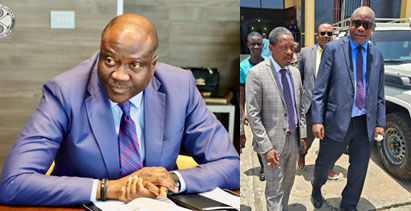
Central Bank of Liberia Governor, Henry F. Saamoi, is to appear and authenticate key financial documents in the ongoing trial of Samuel Tweah and others.
The case is being heard at the Criminal Court ‘C’ in Monrovia.
Saamoi appearing follows a highly technical defense mounted by Mr. Tweah.
He served as Finance during the presidency of George Weah, but faces economic sabotage charge with three others ex-officials.
After taking the witness stand on Monday, April 20, Tweah, (defense’s first witness), delivered a detailed rebuttal to prosecution.
He challenged both its legal foundation and factual assumptions.
Tweah’s testimony, which blended public financial management principles with national security governance, sought to dismantle allegations tied to controversial transfers that involved the Financial Intelligence Agency (FIA).
Under direct examination by defense counsel, Tweah argued that the prosecution had misinterpreted the legal triggers for public spending and failed to fully investigate the operational realities of government finance.
At the heart of his defense was a fundamental claim, that government expenditure does not always hinge on formal “written requests.”
Tweah: “once the national budget is enacted, it legally authorizes spending, while emergency expenditures, particularly those tied to national security, may be executed through high-level consensus without prior documentation.
Government spending does not always depend on written requests.”
He claimed to have legal authority to approve such expenditures.
He further contested claims that direct transfers through the Central Bank were unlawful.”
Tweah described “direct debit transactions” as a recognized fiscal tool often employed during urgent situations and subsequently regularized within the budget framework.
In a move to reinforce his argument, Tweah cited past government transactions totaling tens of millions of U.S. dollars, executed through the CBL to entities such as the National Elections Commission, and international partners, including the World Food Program and UNFPA.
He maintained that these transactions followed the same procedures now being challenged by the prosecution, yet were never deemed illegal.
The defense’s push gained traction when it requested the court to subpoena the CBL Governor to verify documentary instructions tied to those transfers.
Despite objections from prosecutors, who questioned the relevance of the request, the presiding judge overruled the challenge and ordered the issuance of a subpoena.
Saamoi, or a designated representative, is now expected to testify and authenticate photocopied records already admitted into evidence, a development legal observer say could prove ‘pivotal.’
With proceedings set to resume, the court is expected to hear testimony as the defense intensifies its argument that the charges lack a ‘firm legal basis.’