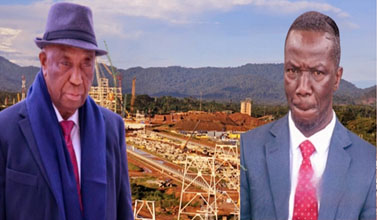
President Joseph Nyuma Boakai first major removal of government officials from positions at ministries and agencies has dealt serious blow to some of his own partisans, one of whom is Wilmot Paye, now former minister of Mines and Energy.
Mr. Paye, up to his removal on Monday, October 27, 2025, was regarded as one of the cabinet ministers of the Boakai-led government, who has been working on timeline to remove hurdles and glitches in the mining sector of the country.
However, the decision by the President to dismiss Mr. Paye and appoint Mr. Richard Matenokay Tingban, seems to spark inquiries as to what might have transpired behind the shutter to warrant the Chief Executive’s power of dismissal.
Multiple speculations, some bordering on policy differences while others point at fighting vices in government have emerged following the dismissal of Mr. Paye thus breeding public debate.
The HPX Deal
Though Paye has been admired since his appointment at the Ministry of Mines and Energy for hard work especially for reprimanding dubious investors in the mining sector, inside sources claimed that he has remained skeptical in falling in line with the HPX Deal, a mining agreement an American is negotiating with the Liberian government under President Boakai.
The American Company is said to have interest in mining the Guinea mountain range to transport extracted iron ores through Liberia via Yekepa in Nimba using the rail to Buchanan Port in Grand Bassa County.
Sources said Mr. Paye’s skepticism has grown out of the total amount HPX has longed for to seal the deal with the government, which he (Paye) is being persuaded to affix his signature to but he has reportedly remained obstinate to bow to executive pressure.
Critics who have followed up on the ups and downs regarding the HPX Deal have insinuated that President Boakai has no other alternative in putting a check to such hurdle from within his inner circle but to fire the Mines and Energy Minister; especially when it was reportedly learnt that Mr. Paye was poised to resign his post.
Wife’s reaction
The wife of the dismissed Mines and Energy Minister, Mrs. Comfort Boo- Paye reacted to the President’s decision in this way: “Thank you for making me a proud wife! Your children are equally very proud of you. Of course, your God is happy to have a child like you. Choosing integrity over wealth is the best choice any true Christian can make. You are a great statesman so posterity will judge you kindly. Thank you for job well done honey!”
Though the Executive Mansion did not provide specific reasons for his removal, Paye’s tenure at the Ministry of Mines and Energy was marked by his strong public stance on mining governance, including recent warnings against illicit mining and calls for greater transparency in the sector. His departure, observers say, could signal a shift in how the Boakai administration intends to manage Liberia’s lucrative mineral industry.
Leaked AML Draft Agreement
As the HPX deal accelerates to seal concession agreement, the Indian giant steel company- ArcelorMittal that operates in Yekepa, Nimba County, seems to have a draft mineral agreement that is likely to undermine President Boakai and the National legislature authorities.
The leaked AML Draft Agreement sourced from government insider is as follows:
Liberian Law and Sovereignty UNDERMINED!
- The proposed AML amendment contains a “shall prevail” clause stating that if any law, regulation, or concession conflicts with AML’s rights, the AML agreement prevails.
- There is no language ensuring that MDA Amendment supremacy is subject to the Constitution and the laws of Liberia. It is one thing to say that failure to honor any contract rights granted AML would entitle it to contract remedies (such as any damages proved to have been incurred thereby).It is a different and unconstitutional approach to grant a private company’s contract rights superiority over future Liberian laws.
- Once ratified, that wording would give a private company’s contract the force of national law, allowing it to override legislation such as the anticipated National Rail Authority Act and the existing Public Procurement and Concessions Act. This provision, once ratified, would allow a private company’s contract to override existing legislation and future laws such as the National Rail Authority Act and other laws in the national interest for development of a fair multiuser rail and port system.
- Such a clause would undermine the principle of legislative supremacy, mandated by the Constitution, shifting ultimate authority over the rail and port system from the Liberian state to a
private entity. It effectively replaces the normal hierarchy of law, where the Legislature and the Courts sit at the top, with corporate self-regulation written into statute.
- This would weaken the Government’s ability to pass or enforce future laws on public infrastructure, taxation, or competition, eroding Liberia’s sovereignty over its own assets leading to another prolonged period of stifled investments in Liberia by parties other than AML as has been the case for the past two decades since 2005.
- Government’s Commitment to the National Rail Authority and the Independent Multi-User Access UNDERMINED!
- The Government has established the National Rail Authority (NRA) to regulate and oversee Liberia’s rail assets and to guarantee independent, multi-user access to all qualified users to be operated by an entity independent of any user to assure fairness and the perception of fairness.
- The AML amendment conflicts directly with that policy: it preserves AML’s operational control of the Yekepa–Buchanan railway well beyond 2030, tying the hand-over to an independent operator to rail traffic volumes that AML itself can influence or control, and allows AML to automatically reassume operatorship if the Independent Operator’s appointment ends “for any reason whatsoever.”
- The Amendment also locks AML’s own rail standard operating principles rules and multi-user agreement (the RSOP and MUA) into law, meaning they cannot be changed without AML’s written consent – stripping the NRA of its ability to set uniform national standards and the Legislature to enact laws to give effect to these principles.
- In effect, the amendment would nullify the Government’s multi-user policy and the core purpose of the NRA: an independent operator model open to all users on fair and transparent terms.
- Concession Law and the Position of Agreements with other Investors/Users—UNDERMINED!
- Under Liberia’s legal framework, each major infrastructure project operates under a ratified concession approved by the Legislature.
- Concession and Access Agreements to any infrastructure for third-party users should remain fully consistent with Liberian concession law: They must respect the Constitution, and the Concessions Act, and the intended NRA Act.
- The AML amendment instead introduces an absolute supremacy clause that would allow one company’s concession to override all others past and future.
- Ratifying AML’s version would therefore create two legal environments – one under the National Rail Authority and another under AML – with AML’s framework claiming to override the national system. This would deter investment, invite legal disputes, and undermine confidence in Liberia’s concession governance.
- Overall Implications
- The AML amendment, as drafted, is incompatible with Liberia’s legal order and declared policy direction. It would:
Weaken sovereign control over national infrastructure; to Undermine the authority and independence of the Government and NRA; to Breach the Government’s public commitment to an independent, multi-user system; and to Create legal uncertainty across all existing and future concessions.
- In its current form, this language should not be approved.
Meanwhile, it is not clear whether Mr. Paye’s dismissal will trigger his departure from the governing Unity Party or undercut his political stance within the party, even if he maintains his membership with the UP now and in the future.