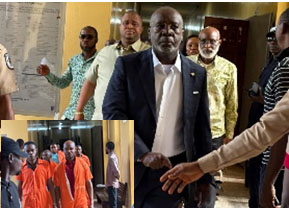
State prosecutors have countered defense arguments in the ongoing trial of former Speaker J. Fonati Koffa and others, insisting that concerns over alleged privacy rights violations cannot override established legal precedent.
In their response to defense objections, the prosecution cited the Sable Mining case involving former Grand Cape Mount County Senator Varney Sherman, where both Koffa and Counsellor Arthur Johnson, once served as prosecuting attorneys. Prosecutors noted that in that case, the Supreme Court upheld rulings that permitted document disclosures and financial audits in the interest of justice.
“The issue of privacy cannot be selectively invoked when convenient,” prosecutors argued. “The same legal standards must apply across the board, particularly in cases tied to criminal allegations.”
They maintained that public interest and the criminal nature of the charges justify their actions, emphasizing that legal precedent leaves no room for exception in the present trial.
Meanwhile, Criminal Court ‘A’ Judge, Roosevelt Z. Willie, has ordered the immediate transfer of all Capitol Arson Attack defendants from Kakata Central Prison in Margibi County back to the Monrovia Central Prison.
Judge Willie cited legal jurisdiction and defendants’ rights to counsel.
The ruling on Tuesday, September 2, followed heated arguments in court over a 32-count motion to suppress evidence filed by defense lawyers.
They alleged constitutional and procedural violations in the state’s handling of the investigation, ranging from “illegal search and seizure” to allegations of “torture and unauthorized forensic analysis.”
However, the court has upheld jurisdiction, right to counsel in one of the issued raised during the argument.
Judge Willie said the ongoing arson trial is being held in Montserrado County, not Margibi, and therefore, “the defendants must be kept within the jurisdiction of the court trying the case.”
He granted the defense’s request to have the defendants returned to Monrovia, stating that their prolonged detention in Kakata undermined their rights to effective legal representation.
“If the Ministry of Justice claims there is no space to hold the defendants at the Monrovia Central Prison,” the judge stated, “then the state must create space, by releasing pretrial detainees, who are eligible for bail, if necessary.”
Not a Political Trial
Amid public interest and growing political commentary surrounding the high-profile case, Judge Willie reiterated that the trial is ‘not political.’
“This court has no intention to keep anyone in prison, who has not committed a capital offense requiring a bond,” he said.
However, Willie also ruled that the bail bond previously submitted on behalf of the defendants was ‘invalid,’ and said three of the accused remain ‘flight risk.’
He said the defendants may be released only upon the posting of appropriate and valid bond instruments.
Defense launches 32-Count Challenge to State’s Evidence
Led by a team of prominent legal counsels, including Counselors Arthur Johnson, Wilkins Wright, and Jonathan Massaquoi, the defense presented a baking motion to suppress prosecution’s evidence, citing constitutional, statutory, and procedural violations.
Cllr. Johnson argued that the National Security Agency (NSA), not the Liberian National Police (LNP), conducted the core investigation despite lacking statutory authority to do so.
Johnson argued that evidence seized during searches lacked proper judicial authorization, and failed to comply with Chapter 11, Section 11.3 of the Criminal Procedure Law.
He stated that the defendants were not present during the search, and seizure operations, thus undermining the legal chain of custody of crucial items, including a chloride bottle allegedly linked to the arson.
Johnson added that the call logs used as evidence were obtained without court order, violating privacy rights under Liberian law, and lacking authentication.
“The Liberia Petroleum Refining Company (LPRC) conducted forensic analysis without legal authority, and failed to notify the defendants of its examination process,” Cllr. Johnson argued.
He further alleged that the defendants were tortured and sodomized during their detention at the NSA, calling the investigative process “clandestine, uncivilized and barbaric.”
Prosecution Denies Violations, Defends NSA’s Involvement
One of the state prosecutors, Counselor Richard Scott, rejected the motion in its entirety, urging the court to dismiss it and allow the trial to proceed.
Cllr. Scott argued that the NSA’s involvement was legally authorized by the Ministry of Justice, citing the agency’s technical expertise.
He said search and seizure actions were approved by the court, and the defense’s acknowledgment of these requests contradicts their suppression arguments.
On the issue of call logs, Scott cited precedent from the Civil Mining Case involving Counselor Varney Sherman, stating that privacy does not apply in criminal investigations.
He noted that credible evidence of torture was presented, and the majority of the state’s evidence is digital in nature, undermining the argument that it was obtained through coercion.
He therefore dismissed the motion as a delay tactic, stating: “The defense is simply trying to prevent this case from moving forward.”
The Capitol Arson case, stemming from a suspected political attack on Capitol Building, has attracted significant national attention, with implications for civil liberties, the rule of law, and the proper limits of state investigative powers.
The court is expected to rule on the motion to suppress evidence on Thursday, September 4, 2025.