By Godgift Harris
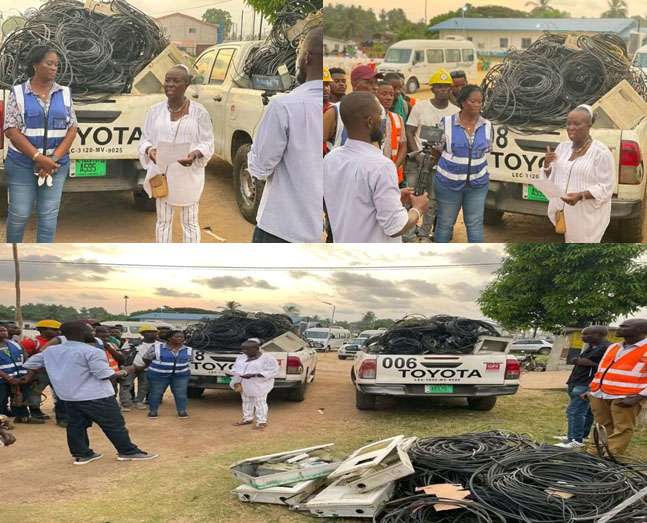
“…electricity theft will no longer be overlooked. when we catch you stealing current, you will pay for all that you have used,”—Madam Broh
A sweeping anti-power theft operation spearheaded by the Liberia Electricity Corporation (LEC), has placed dozens of individuals and businesses under scrutiny.
The Corporation intensify efforts to curb illegal connections being described as “economic sabotage” within the fragile electricity sector.
At the center of the renewed enforcement drive is Mary T. Broh, head of LEC’s anti-power theft taskforce.
Madam Broh has meanwhile, issued a stern warning to perpetrators of illegal electricity connections.
During a recent enforcement exercise, Madam Broh made it unequivocally clear that “electricity theft will no longer be overlooked.”
“When we catch you stealing current, you will pay for all that you have used.”
She as LEC technical teams, backed by security officers, moved from community to community disconnecting illegal lines, dismantling bypass systems, and documenting unauthorized hookups.
The operation, described by LEC management as one of the most aggressive in recent years, has already resulted in multiple disconnections and arrests.
Entire clusters of homes and businesses were found tapping directly into distribution lines, bypassing meters, or manipulating existing connections to avoid payment.
A System under strain
Electricity theft remains one of the most pressing challenges confronting LEC.
According to officials, illegal connections account for significant system losses, depriving the Corporation of much-needed revenue required to maintain infrastructure, purchase power, and expand services to underserved areas.
LEC authorities argue that the financial hemorrhage caused by power theft undermines national development and places an unfair burden on law-abiding customers, who pay their bills regularly.
“Every time someone steals electricity, it affects the entire system. It means honest customers are paying more, and development is delayed,” Madam Broh.
Technical experts within the Corporation explain that beyond financial losses, illegal hookups pose serious safety risks.
Improvised connections and bypass lines often lead to electrical fires, transformer overloads, and power fluctuations that damage appliances and critical infrastructure.
In several communities visited during the operation, LEC engineers discovered dangerously exposed wires hanging across rooftops and narrow alleyways, posing hazards to children and residents.
The crackdown has not been limited to warnings, security personnel accompanied LEC teams to ensure compliance and prevent confrontation.
In some neighborhoods, resistance was reported as affected residents questioned the timing and intensity of the enforcement campaign.
However, LEC officials insist the action is “lawful and necessary.”
They disclosed that customers caught stealing electricity will be billed retroactively for estimated consumption, and may face prosecution under the electricity laws.
Broh stressed that the exercise is not intended to harass law-abiding citizens, but to restore discipline and accountability within the power sector.
“This is about fairness. Electricity is a service that must be paid for. We are protecting the system for everyone.”
Public frustration and meter delays, while many residents acknowledge that electricity theft is wrong, some citizens interviewed in Monrovia, expressed frustration over “lengthy delays in obtaining official LEC meters.”
One resident told journalists that he has been waiting more than three months for a meter despite repeated follow-ups.
Such complaints raise critical questions about systemic bottlenecks within LEC’s customer service operations.
LEC management has yet to provide detailed data on meter supply challenges, but maintains that theft cannot be justified under any circumstance.