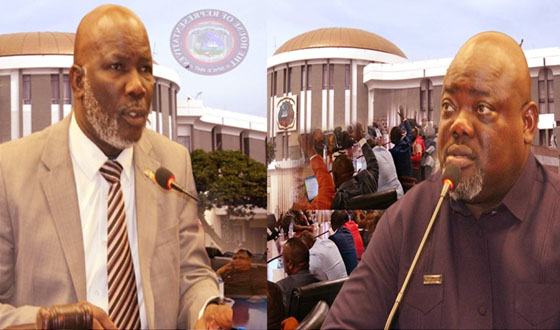
Latest reports have optional plan to remove the Speaker of the 55th Legislature, Richard Nagbe Koon, and his Deputy, Thomas Fallah (T-Five).
The reports confirmed how 22 of the 73 lawmakers met in the Police Academy community on Monday, December 22, 2025, and discussed the plan to oust Koon and Fallah.
Insider sources confirmed how the meeting brought together several representatives from the majority bloc, who have now aligned with members of the minority bloc over “growing concerns about leadership and accountability within the House.”
Persons acquainted with the working of the Legislature said, the lawmakers have agreed to jointly sign a ten-count resolution that will call for the ousting of
The Speaker of the House of Representatives, his Deputy as well as
Four other members of Ways, Means, and Finance Committee, and a member of Rules and Order Committee.
It is further reported that the 22 lawmakers, have turned aggrieved, mostly are from the majority bloc that are “loyal to Speaker Richard Koon.”
They reportedly cited an alleged lack of accountability, poor and irresponsible leadership, marginalization of members, usurpation of committee functions, and financial malpractices.
As part of their agreed actions, the distraught lawmakers have resolved to initially boycott President Joseph Nyuma Boakai’s upcoming State of the Nation Address (SONA).
They have also agreed to deny Speaker Koon a quorum in future sittings of the House as another means of pressing with their demands to remove him and his deputy.
The raise of Koon and Fallah at the speakership
After months of legal battles, political standoffs, and a final constitutional reckoning, Koon was on Tuesday, May 13, 2025, overwhelmingly elected as Speaker of the 55th Legislature following the resignation of J. Fonati Koffa, then speaker.
Koon secured 43 votes, defeating Nimba County Representative Musa H. Bility, who garnered 26, in the vote that followed months of bitter political wrangling.
The election marked the official close of a months-long speakership dispute that paralyzed the legislature.
The resignation of Koffa
Grand Kru County lawmaker and opposition figure, on Monday, May 12, set the stage for the vote. He cited a deteriorating security environment and deepening factionalism as factors influencing his decision, despite a Supreme Court ruling affirming his legitimacy and invalidating previous attempts to install Koon through irregular legislative processes.
“If I resign, that’s the inevitable part of the law that a new speaker has to be elected. The vacancy is created.”
Koffa’s departure ended a tumultuous chapter in Liberia’s legislative history. For months, the country had two parallel Houses operating: one led by Koffa, and another, by self-styled “majority bloc” then led by Koon.
In an April 23 ruling, the Supreme Court declared Koon’s prior claim to the speakership unconstitutional, and voided all legislative actions taken under his direction, including the passage of the 2025 national budget.
The Court affirmed that, under Articles 33 and 49 of the 1986 Constitution, only the elected speaker, or in his absence, the deputy speaker can preside over sessions with a quorum.
“Speaker Koffa not being absent to preside over plenary sessions, the Deputy Speaker or any representative… could not legally preside,” the Court ruled. “Any action or sitting by the majority to the exclusion of the Speaker… is unconstitutional and without the appeal of the law.”
The ruling declared the existence of a second, parallel plenary as illegal and nullified major acts taken by Koon’s bloc, including salary withholdings, budget enactments, and attempts to recall ECOWAS lawmakers.
The Court also dismissed a legal opinion from the Attorney General that had sought to validate Koon’s earlier actions.
Despite the legal rebuke, Koon, a Unity Partisan, remained defiant. Even before Tuesday’s formal election, he had publicly declared himself the “regime Speaker,” vowing to align the House’s agenda with the Boakai administration.
“Today, I am the regime Speaker, and I am 100 percent supporting the President,” Koon said in February.
He added: “No speaker from the opposition will promote our agenda.”
With Koffa out and Koon now elected through a constitutionally sanctioned process, some observers hope the Legislature can begin to heal. But tensions remain high, and the scars of the crisis reportedly continue deepening.
As Koon prepared then to take full control of the Speakership, he faces not only the challenge of unifying a deeply divided House, but also restoring public trust in a Legislature many Liberians now view as an arena for partisan warfare rather than national service.
Source: Evidence TV contributed to the story