By Godgift Harris
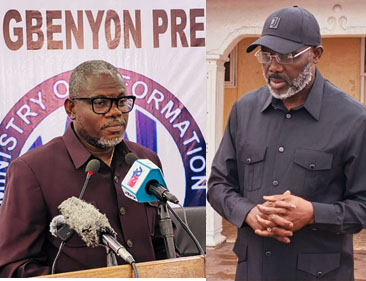
. . . after devoting a substantial portion of the Ministry’s official platform to attack George Weah and officials, Piah did not outline concrete achievements and progress of the UP-led government,”-critics have said.
Information Minister Jerolinmek Matthew Piah, has himself to blame as he faces mounting public criticisms having blasted the erstwhile CDC-led government for country’s present woes.
The development followed Piah’s year-end press briefing in Monrovia, during which he deviated from progress reports to the former.
After devoting a substantial portion of the Ministry’s official platform to attack former President George Weah and officials, Piah failed to outlined concrete achievements and progress of the Unity Party-led government.
During the regular press briefing held on Tuesday, December 30, 2025, at the Ministry of Information, Piah reportedly spoke for about 45 minutes, focusing largely on alleged misconduct under the Weah administration (2018-2024).
Among the most contentious claims, Mr. Piah alleged that Weah constructed as many as 49 residential buildings using taxpayers’ money for personal benefit and misused state resources.
He further referenced the controversial handling of billions of Liberian dollars said to have gone missing during the CDC era.
While also citing past statements by Weah’s Finance and Development Planning Minister, Samuel D. Tweah, who had claimed that significant sums were injected into the foreign exchange market to stabilize the Liberian dollar.
Tweah, being sanctioned by the U. S. Government, is currently facing trial on corruption-related charges.
However, critics argue that Piah’s emphasis was “misplaced and unproductive,” particularly as the UP-Administration approaches two years in office.
Political observers and civil society actors, say Liberians are increasingly impatient for detailed accounts of what the current government has achieved in terms of governance reforms, economic recovery, and improvements in living standards.
Many pointed out that the CDC government was voted out precisely, “because citizens demanded change.”
And that continued fixation on the past does little to address pressing “bread-and-butter” issues confronting ordinary Liberians, including the rising cost of living, unemployment, deteriorating road networks, and limited access to basic public services.
“The Information Ministry should not be used primarily as a platform to attack former officials,” a civil society actor told this newspaper.
“Liberians want to hear what the Rescue Mission has delivered so far, not a repetition of narratives about past failures.”
Critics further contended that several urgent national concerns deserved attention during the briefing, but were either glossed over or ignored.
Among them are persistent questions surrounding the reported US$40 million expenditure by the Ministry of Public Works on the Southeastern road corridors, where road users continue to face severe transportation challenges.
The issue has drawn enough public outcry that the Public Works Minister was recently summoned by the Legislature to explain the poor state of roads in the region.
Internal challenges
Internal challenges among staff at the Information Ministry have also attracted scrutiny.
Earlier Tuesday, Deputy Information Minister for Public Affairs, Daniel O. Sando, appeared on a local radio station and disclosed that the Ministry is grappling with serious financial constraints.
When journalists later questioned him about the continued absence of the New Liberia Newspaper from newsstands,
Sando shifted responsibility to Assistant Minister Rufus Paul, who oversees the publication.
Additional concerns were raised about the prolonged shutdown of the Liberia News Agency (LINA) website, which has reportedly been offline for more than months, further limiting public access to official government information, and undermining transparency.
Political commentators maintain that while accountability for past administrations remains important, the core mandate of the Information Ministry is to keep the public informed about performances, challenges, and achievements of the government.
As the Unity Party continues to promote its “Rescue Mission” agenda, many Liberians insist that official briefings should prioritize clear solutions, policy reforms and measurable progress that directly affect their daily lives, rather than extended focus on former leaders, who are no longer in office.