By Godgift Harris
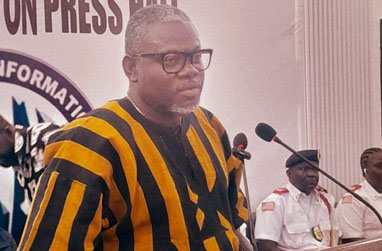
Information Minister Jerolinmek Matthew Piah on Tuesday delivered one of Pres. Boakai administration’s most combative public warnings.
Piah condemned “a rising tide of lawlessness, political manipulation and attacks on state authority and other peaceful citizens.”
He spoke at the Ministry of Information regular press briefing on November 18.
His remarks quickly shifted from policy updates to a sweeping denunciation of political actors, he accused of “sabotaging national stability.”
Piah warned bluntly that the government would “come after anyone who violates the laws,” insisting that the era of impunity that characterized past administrations must never return.
“Liberia has long suffered from calculated plunder by individuals driven by personal and political greed.”
He said Liberians “are not willing to go back to the days when people took the law into their own hands.”
In a pointed accusation widely interpreted as referencing opposition figure Simeon Freeman, political leader of the Movement for Progressive Change (MPC), Piah unloaded a barrage of criticisms, describing an unnamed politician as “confused, unserious, spineless and visionless.”
He further accused the opposition leader of poor labor practices, citing alleged mistreatment of workers within the DSTV operations.
While Piah avoided calling Freeman by name, the minister’s comments left little doubt about the intended target.
“The political leader is not serious. He is a very confused individual,” he declared, escalating an already tense relationship between the government and several opposition blocs.
Piah also accused unnamed political and civic actors of interfering with court proceedings for personal and partisan advantage.
He warned that no figure whether political, business, or religious should expect protection from prosecution if found undermining the law.
In a further warning, he condemned the growing use of religion and regional identity as political weapons.
He meanwhile, urged Liberians to reject any attempt to inflame tensions based on faith or geographic background.
“Regional politics is bad for any country. Pres. Boakai will not allow division based on Christian, Muslim, or any other faith, the law is the law,” Piah insisted.
Despite the heated political tone, Piah highlighted ongoing infrastructure projects in Bomi, Grand Cape Mount, and Gbarpolu counties, areas he referred to as “collective corridors” essential to national recovery.
He also announced upcoming rehabilitation works from Johnson Street’s New Bridge, through Clara Town, and onward to the Freeport and Bushrod Island corridor.
Some analysts viewed as symbolic political messaging, Piah said government is working to ensure former President George M. Weah can travel by road to his hometown in the Southeast before the dry season ends.
Piah’s latest comments come at a politically sensitive time, with the opposition accusing the Boakai administration of exhibiting authoritarian tendencies and intolerance toward dissent.
Analysts warn that such aggressive public statements, especially those seen as targeting opposition leaders risk heightening political tensions and undermining efforts to promote national reconciliation.
While supporters defend Piah’s warnings as necessary to enforce the rule of law, critics argue that the administration’s rhetoric is becoming increasingly confrontational, raising concerns about democratic space, political freedoms and the government willingness to tolerate criticism.
As political polarization deepens, Piah’s message delivered with unusually sharp language appears poised to intensify Liberia’s already heated national debate over governance, accountability and respect for democratic norms.