By: Godgift Harris
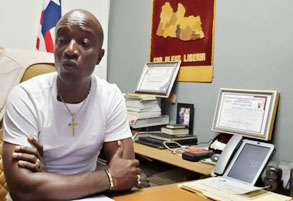
The Patriotic Entrepreneurs of Liberia (PATEL) has formally distanced itself from a planned protest allegedly being organized under its name, while at the same time commending the Government of Liberia for recent efforts to support local businesses.
Speaking at a press conference in Monrovia, PATEL National Chairman, Dominic Nimely, said the organization has not authorized any protest against the government or the private sector and warned the public against individuals using the PATEL name without approval.
“PATEL is not staging any protest, and we are not part of any action against the government or the private sector,” Nimely said.
“Anyone calling for a protest under our banner is acting in his personal capacity and does not speak for PATEL.”
According to him, a former official of the organization has been circulating statements and flyers on social media calling for a protest, initially using the PATEL name before later rebranding the action as an “economic movement” after realizing it was improper.
He said PATEL leadership consulted senior stakeholders and business leaders, who advised that dialogue not confrontation remains the most effective way to address concerns.
While ruling out protest actions, the PATEL Chairman raised serious concerns affecting Liberian-owned businesses, particularly the poor quality of services provided by GSM companies operating in the country.
He lamented persistent call failures, delayed connections, dropped calls, and unreliable internet services, despite Liberians paying some of the highest telecommunications tariffs in the region.
“You can be sitting right next to someone and still struggle to make a call. Sometimes the phone rings minutes later as a missed call,” Nimely said.
“We are paying more than people in neighboring countries, yet we are not enjoying reliable service.”
Nimely disclosed that PATEL had previously contemplated protest actions over the deteriorating quality of GSM services but decided instead to engage lawmakers, regulators, and relevant sector authorities.
However, he noted that despite repeated discussions and promises, there has been little improvement and services continue to decline.
PATEL has called on the government to urgently convene a meeting with GSM operators to ensure they invest in modern equipment comparable to what is used in other African countries and improve service delivery to consumers.
The PATEL Chairman also criticized the implementation of Liberia’s liberalization policy, arguing that it has largely failed to protect Liberian-owned businesses.
He noted that sectors legally reserved for Liberians such as wholesale, retail and supply are increasingly dominated by foreign nationals, particularly Lebanese, Indian and Chinese traders.
“They come claiming to be investors, but instead of bringing fresh capital, they take loans from our local banks, crowding out Liberian businesses,” Nimely said.
“At the end of the day, Liberians remain stagnant while foreigners expand.”
Despite these concerns, PATEL acknowledged and praised the government for positive steps taken in support of Liberian businesses.
He commended the current administration for including business associations in the national budget for the first time in years
Noting that the Liberia Business Association and related bodies received budgetary allocations, though modest.
He also lauded President Joseph Nyuma Boakai for consistently engaging foreign businesses and insisting that they genuinely invest and partner with Liberians rather than dominate the economy.
Additionally, Nimely highlighted the issuance of service passports to Liberian businesspeople and the government’s sponsorship of private-sector participation in international trips, describing these measures as unprecedented compared to previous administrations.
“When the government does well, we must say it,” Nimely said.
“But we must also ask them to do more in the interest of Liberian businesses.”
Responding to questions, the PATEL Chairman maintained that while protests may sometimes attract attention, they are not always the best solution.
He renewed his call for President Boakai to meet directly with Liberian business associations, chambers of commerce and sector actors to hear their concerns firsthand and take decisive action.
“Two years is enough time,” Nimely said.
“The President needs to sit with us and understand what Liberian businesses are going through.
We are ready for dialogue and action, not noise without results.”
PATEL reaffirmed its commitment to peaceful engagement, constructive criticism and collaboration with the government to ensure Liberians become active participants not spectators in their own economy.