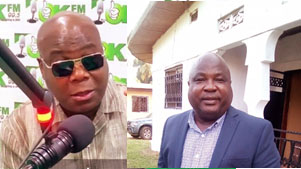
The Chairman of the opposition National Patriotic Party (NPP), George Sylvester Mulbah, has strongly criticized the ruling Unity Party-led government.
Mulbah accused UP of “deliberately undermining the rule of law, and failing to promote inclusive governance.”
He made the statement during an interview with reporters in Gbarnga on Monday, December 29, 2025.
Mulbah, a lawyer by profession, said, several actions taken by the Joseph Nyuma
Boakai administration represent “clear and flagrant violations of the legal framework, particularly regarding the Code of Conduct, and the removal of tenure-protected officials.”
He added: “One of the most troubling developments is government’s decision to proceed to court, while allegedly ignoring provisions of the Code of Conduct, especially in relation to the UP Secretary General, who also serves as a Managing Director of a public corporation, and is a co-signatory to the Party’s bank account. We think that is undermining the rule of law.”
Mulbah said, such actions set a dangerous precedent for governance.
He further condemned the removal of officials occupying tenure positions without judicial decisions, noting that those officials were legally appointed, and protected by statutes enacted by the Legislature.
“This government removed people who were legally appointed, and enjoyed tenure without any court ruling. That was a clear, flagrant violation of the law of this country, and the government is condemnable for that.”
Mulbah recalled a similar situation during the Coalition for Democratic Change (CDC) administration, when attempts to remove tenure-protected officials were overturned by the Supreme Court, resulting in reinstatements, and in some cases, paid compensation.
“History will not take this lightly,” warning that the UP is ignoring established legal precedents.
Beyond legal concerns, Mulbah also raised issues about the over-centralization of power within the UP, and the lack of inclusiveness in government appointments.
He claimed that key positions are disproportionately occupied by individuals from Lofa County, a situation he said, mirrors regional imbalance seen during the CDC era.
“This is a very small country. To have a reconciled Liberia, you must practice inclusiveness, especially along geographical lines.”
Mulbah noted that exclusion fuels political tension, and deepens national division.
He warned that failure to address these concerns could negatively affect UP’s political future, including the 2029 election; if deliberate steps are not taken to engage opposition parties and promotes reconciliation.
Mulbah also criticized the influence of political and job returnees from abroad, whom he said, often lack an understanding of local realities, and show little long-term commitment to the country.
“When things get spoiled here, they have a second home. They don’t care.”
Despite his criticisms, Mulbah acknowledged that Pres. Boakai is making efforts in infrastructural development, citing ongoing road constructions, and bridge projects across the country.
Source: Kongoi Gborkorquellie/Spoon TV
Journalist Critiques Boakai’s Regime
Rodney D. Sieh, Managing Editor and Publisher of FrontPage Africa, one of local dailies, has raised series of concerns about the direction of Liberia’s governance.
Journalist Sieh warned that the ruling Unity Party (UP) is operating with an “exclusionary posture” that could endanger democratic stability and national cohesion.
As a guest on OK FM Show, Sieh cautioned that the UP is governing as though it achieved a sweeping electoral mandate, despite securing a narrow victory in the 2023 general elections.
He argued that such an approach ignores the divided verdict delivered by the electorates, and risks deepening political and social divisions.
Sieh: “The close outcome of the elections should have compelled the Boakai administration to prioritize inclusiveness, dialogue, and consensus-building, rather than a ‘winner-takes-all’ governing style.
UP is governing like they won a landslide election, which is dangerous,” Sieh warned. He said Liberia’s history demonstrates how exclusionary governance erodes public trust and fuels instability.
Sieh recalled how the 2023 elections reflected a demand for shared national responsibility, and broader participation in governance, particularly at a time when the country faces economic challenges and lingering issues of reconciliation.
meanwhile, Sieh has urged the government to meaningfully engage opposition political parties, civil society organizations, and other national stakeholders, especially on issues related to economic management, governance reforms, and national healing. He further warned that dismissing dissenting voices could heighten political tensions, and weaken the administration’s ability to fulfill its promises to ordinary Liberians.
The media executive’s remarks come amid increasing public debate over UP’s early months in office, with critics calling for broader inclusion and defenders of the government insisting it has the right to implement its policy agenda.
Beyond the executive branch, Sieh delivered a scathing assessment of the Legislature, describing it as “a tragedy” and accusing lawmakers of operating without accountability, proper vetting, or respect for democratic oversight, particularly the role of the media.
“The legislature is a tragedy. It is the worst group of people ever assembled in our history.”
Sieh pointed a “poorly crafted legislation and reckless decision-making.”
“You look at the bills that they have been passing lately, no accountability.”
He argued that the legislative crisis is not new, rather a persistent failure that successive administrations have failed to address.
Sieh also condemned a “recent attack on the media by Speaker Richard Nagbe Koon, which followed reporting of the media that sought to hold legislative leaders accountable.
“The speaker attacked the media recently for holding him accountable.”
Sieh added: “Such actions reveal a lack of understanding of democratic responsibility, warning that hostility toward the press reflects a deeper leadership and governance deficit.”
“They held government accountable. They put government feet to the fire for you to be where you are today. You get there, and you attack the media. What does it say about you? It says you are incompetent. You don’t know the role of the position you hold.”
Sieh further criticized “Liberia’s entrenched culture of political sycophancy in which public officials rally unquestioningly around those in power, often at the expense of national interest.”
“They pretend that it’s part of our culture. Every government comes, they rally around the president and destroy the country.”
He expressed concern over a “governance environment driven by confrontation, rather than service delivery.”
“Every other day, this government not the president, but the officials are fighting people. They are fighting the media. They are fighting officials of the previous governments. They are fighting everybody.”
Sieh’s comments have added momentum to an ongoing national conversation about democratic accountability, legislative oversight, media freedom, and the broader quality of governance issues that continue to resonate amid growing public frustration and demands for reform.
Source: By Sam Middlevic Karto/Insights Liberia