By Julius Konton
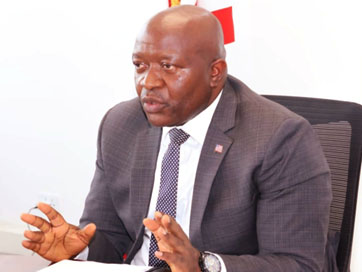
The Minister of Finance and Development Planning, Augustine Kpehe Ngafuan, has mounted a robust defense of government’s economic record.
Ngafuan defense followed President Joseph Nyuma Boakai’s third State of the Nation Address.
He insisted that infrastructure-led growth not political rhetoric, is already reshaping the country economic fundamentals.
Ngafuan acknowledged mounting criticism from opposition figures, and economic skeptics, but framed the debate as a normal feature of democratic governance.
“The government will continue to do its work, and the critics will continue to do their work, which is to criticize. Projects are implemented for the Liberian people, not for the ownership of any particular government.”
Roads, not politics at the center of growth strategy
At the heart of government’s economic argument is road connectivity, which Ngafuan described as central to “bread-and-butter” economy linking farmers to markets, reducing transportation costs, and easing inflationary pressure.
He criticized the personalization of public infrastructure projects, particularly claims of “ownership” over roads.
“If someone had already done the road, we wouldn’t be constrained to do it again.”
The road network remains among the least developed in West Africa, with fewer than 20 percent of roads paved nationwide, a factor long cited as a constraint to private investment and agricultural commercialization.
Ngafuan highlighted energy access as the single most binding constraint to growth.
When the Boakai administration assumed office, national electricity access stood at just under 30 percent, according to government and development partner data.
That figure has now risen to approximately 39 percent, driven largely by increased generation from the Mount Coffee Hydropower Plant and grid expansion in urban and peri-urban areas.
“We came and met electricity access at around 30 percent. Today it is about 39 percent. Our ambition under the new MCC Compact between now and 2029 is to push that figure beyond 75 percent.”
Liberia has recently been declared eligible for a second Millennium Challenge Corporation (MCC) Compact, with energy once again selected as the priority sector, a signal of international confidence in the government’s reform agenda.