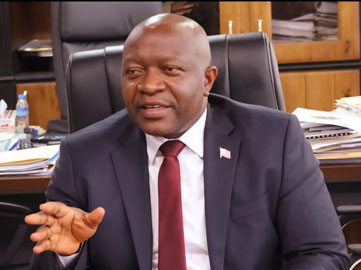
Finance Minister, Augustine Kpehe Ngafuan, says the country’s admission into the next phase of negotiations for a second U.S. Millennium Challenge Corporation (MCC) Compact is nothing short of a national blessing.
Ngafuan attributed the success story to hard work, faith, and “a visionary leadership of President Joseph Nyuma Boakai.”
He spoke to reporters on Thursday, December 11, shortly after he received an official communication from the MCC’s Head of Compact Operations for Africa late Wednesday night.
He said, the announcement left him “elated and ecstatic,” noting that Liberia had “reached a point many thought impossible.”
“When I got the email around 10:30 p.m., I felt that God loves Liberia.”
“This is the result of President Boakai’s leadership, the hard work of the team here, and the commitment of the Liberian people.”
Ngafuan said, the MCC’s investments have direct impact on everyday life particularly through energy expansion, which he called: “Engine of the private sector.”
He reminded the public that Liberia’s first MCC Compact in 2015, delivered US$257 million, largely used to rehabilitate the Mount Coffee Hydropower Plant, which today powers parts of Monrovia.
With national energy access still at 33 percent, the government aims under its newly completed Liberia Energy Compact to increase access to 75 percent within five years, while reducing the cost of electricity.
“If power becomes affordable, businesses become profitable. When businesses get profitable, they expand. When they expand, they hire.”
“This is how development touches the ordinary man in Voinjama or Lougatuo,” said Ngafuan.
He said, MCC funding comes as grants, not loans, unlike other multilateral financing that increases Liberia’s debt burden.
Though the exact amount of the second compact is yet to be announced, Mr. Ngafuan confirmed consultations begin immediately.
“Some people are saying US$300 million, some US$500 million. It could be above or below US$500 million. The final figure depends on the projects we agree on in the coming days.”
According to Ngafuan, MCC assessments once again identified energy and road infrastructure as top constraints to growth.
Liberia is already aligning its budget to signal these priorities, allocating US$100 million to energy and roads from projected revenue increases.
He pointed to improvements in road connectivity, especially in the Southeast, as the reason food prices have stabilized, and inflation dropped below 5 percent last month.
“Nobody asks for party ID cards to use roads or to get electricity. Development is how we unite the country.”
Mr. Ngafuan revealed that Liberia’s progress came despite major shifts in U.S. foreign assistance priorities under President Donald Trump.
The MCC increased its scorecard indicators from 20 to 22, and doubled its “hard hurdles” corruption, and now freedom. Failing either automatically disqualifies a country.
“Liberia passed both hard hurdles and 12 of the 22 indicators. Some big countries in our region did not pass. Sixteen were dropped. Liberia made it.”
Ngafuan credited the success to the credibility and negotiating posture of Pres. Boakai’s administration:
“We have a leader who doesn’t talk much, but works hard. The Americans saw a credible, competent, visionary government.”
The government he said, will meet MCC officials via Zoom to begin formal discussions on project scoping and funding levels.
He called on Liberians to remain patient as the process unfolds: “Some challenges we met were not at zero, they were below zero. Getting back to zero takes effort. But we are moving into positive territory.”
Mr. Ngafuan meanwhile, messaged Liberians with unity and gratitude.
He added: “This is Liberia’s victory. We worked together across ministries, partners, and the Liberian people. And God loves Liberia.”