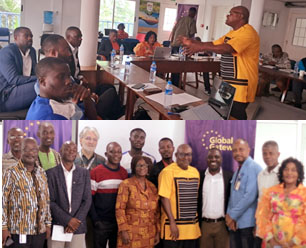
The National Elections Commission (NEC), has taken a major step to strengthen transparency, public participation, and institutional coordination in the upcoming boundary delimitation review.
In a day‑long advocacy strategy session held at the European Union Delegation offices in Monrovia on Wednesday, February 18, 2026, NEC convened civil society organizations (CSOs), media practitioners, and electoral stakeholders, collectively charted the path toward a credible and people‑centered review process.
The gathering, according to a release, was organized under the UNDP Liberia Electoral Support Project.
It was implemented by NEC and UNDP with support from the European Union, Irish Aid, and the Government of Sweden.
The process also marked a significant moment in electoral reform journey.
Participants confronted challenges, clarified their roles, and aligned visions around a shared democratic purpose.
A Call to Collective Responsibility
NEC Chairperson Davidetta Browne Lansanah, spoke about civic responsibility, and the essential role of CSOs in safeguarding transparency.
Madam Lansanah remarks highlighted how civil society remains a crucial bridge between institutions and citizens assuring that information flows accurately; communities stay informed, and the public remains engaged throughout the boundary review.
She reaffirmed NEC’s unwavering commitment to conduct the exercise “in a transparent, inclusive, and lawful manner.”
Madam Lansanah also underscored the genuine stakeholder engagement, which she said, was not optional, but foundational to achieve a credible outcome.
Roosevelt Zayzay, UNDP Program Officer with the Liberia Electoral Support Project said, the delicate nature of boundary delimitation and managing its sensitivity through collaboration.
Zayzay noted that these processes carry significant technical, political, and social implications, requiring robust coordination and strategic communication to reduce risks and strengthen public trust.
His remark reinforced the importance of a multi‑stakeholder approach; one that brought together technical experts, communicators, and community actors, who jointly navigated the complexities of the review.
Participants engaged in evidence-driven conversations around the unique boundary delimitation challenges, including gaps and inconsistencies in administrative and geographical data; public misconceptions about what boundary delimitation means for constituency representation; the need for clearer institutional responsibilities; limited public awareness of the purpose, and impact of boundary changes and the importance of strengthening civic engagement and media outreach.
Stakeholders meanwhile, examined specific risks, including the potential for misinformation, politicization of the process, and logistical constraints if roles and expectations are not clearly aligned.