By: Godgift Harris
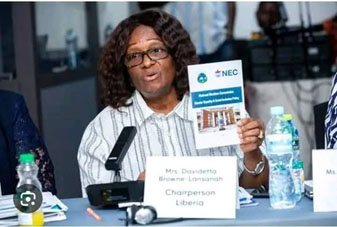
The decision by the Chairperson of the National Elections Commission of Liberia (NEC), Davidetta Browne Lansanah, to step down from her position effective March 15, 2026, has triggered renewed debate about the state of electoral governance and accountability in Liberia.
In a formal letter addressed to President Joseph Nyuma Boakai Sr., Lansanah indicated that her decision followed consultations with her family and a personal desire to take time off to rest after more than twelve years of service to the Commission.
While the explanation appears straightforward on the surface, political observers and electoral analysts say the timing of the resignation raises broader questions about leadership stability at the country’s electoral management body.
Lansanah made the disclosure on Thursday, March 12, 2026, during her closing remarks at the conclusion of a tour of ongoing renovation works at the NEC headquarters located on 9th Street in Sinkor, Monrovia.
The event was attended by representatives of the Liberian government, development partners, members of the diplomatic community, and other electoral stakeholders.
Her announcement, delivered in what witnesses described as a calm but reflective tone, effectively ends a long tenure that has seen her serve both as a Commissioner and later as Chairperson of the NEC.
During this period, she presided over some of the most consequential electoral processes in the country’s post-war democratic transition.
Yet her departure comes at a time when Liberia’s electoral credibility continues to face scrutiny from political actors, civil society groups, and segments of the public who have raised concerns about transparency, logistical preparedness, and the independence of electoral institutions.
A Long Tenure Under Scrutiny
Davidetta Browne Lansanah first joined the National Elections Commission as a Commissioner before rising to the position of Chairperson, becoming one of the most recognizable faces in Liberia’s electoral administration.
Throughout her tenure, she oversaw multiple national and local elections, including presidential and legislative polls that shaped the country’s democratic trajectory.
Supporters credit her leadership with helping to maintain institutional continuity and guiding the NEC through complex electoral cycles.
However, critics argue that the Commission under her leadership also faced persistent operational challenges, including disputes over election results, complaints about delayed processes, and accusations from political parties alleging irregularities in electoral procedures.
These criticisms, though often contested by the Commission, contributed to an atmosphere of skepticism that has periodically surrounded Liberia’s electoral system.
Political commentators say Lansanah’s resignation provides an opportunity for the government to reflect on how the NEC can strengthen public trust in elections a critical pillar for democratic governance in a country still navigating the legacy of political instability and civil conflict.
The Official Explanation
In her letter to President Joseph Nyuma Boakai Sr., Lansanah framed her decision primarily as a personal one.
According to her communication, the choice to step down followed extensive discussions with her family and was motivated by a desire to rest after more than a decade of service to the Commission.
She described her years at the NEC as both an “honor and privilege,” emphasizing the importance of the institution in safeguarding Liberia’s democratic system.
“The work of the Commission remains vital to sustaining Liberia’s democracy,” she noted, reaffirming her belief in the importance of credible electoral administration.
Lansanah also pledged her full cooperation to ensure a smooth transition once a new Chairperson is appointed, a commitment observers say is critical to maintaining institutional stability within the Commission.
Questions About Timing
Despite the personal reasons cited for her resignation, the timing has drawn attention from political analysts.
Liberia’s electoral environment has remained highly sensitive following recent election cycles that exposed deep political divisions and heightened public expectations for transparency.
Some observers argue that leadership changes at the NEC should be accompanied by broader institutional reforms aimed at improving efficiency, strengthening legal frameworks, and increasing public confidence in electoral outcomes.
Others believe the resignation may simply reflect the natural conclusion of a long public service career.
Still, critics say the government must ensure that the process of appointing a successor is conducted transparently and without political interference.
“The credibility of the next NEC leadership will depend heavily on the perception of independence,” one political analyst in Monrovia noted.
“If the public believes the appointment is politically motivated, it could deepen distrust in the electoral process.”
The National Elections Commission of Liberia has long faced structural challenges that extend beyond individual leadership.
These include logistical difficulties in conducting elections across Liberia’s difficult terrain, budgetary constraints, and the need for continuous voter education in rural communities.
Additionally, political tensions often place the Commission under intense scrutiny, particularly during periods of close electoral contests.
Civil society organizations have repeatedly called for reforms that would strengthen the independence and capacity of the NEC, including improved funding mechanisms and enhanced oversight procedures.
Some analysts argue that leadership changes alone cannot address these deeper systemic issues.
Instead, they say, meaningful reforms must involve collaboration between government institutions, political parties, and international partners who support Liberia’s democratic development.
Reaction From Stakeholders
Following the announcement, reactions from electoral stakeholders have been mixed.
Some political figures have expressed appreciation for Lansanah’s years of service, acknowledging the difficulties inherent in managing elections in a highly polarized political environment.
Others, however, believe the transition presents an opportunity to re-evaluate the Commission’s performance and introduce reforms that would enhance transparency and accountability.
International partners who support electoral processes in Liberia are also closely monitoring the situation, particularly because external support has historically played a key role in strengthening the country’s democratic institutions.
Diplomatic observers attending the event where the resignation was announced emphasized the importance of maintaining institutional stability during the transition period.
For more than a decade, Davidetta Browne Lansanah has been at the center of Liberia’s electoral administration.
Her leadership spanned critical moments in the country’s democratic consolidation, including high-stakes elections that tested the resilience of the nation’s political institutions.
Supporters argue that despite the challenges, the NEC under her watch managed to conduct multiple elections without descending into widespread violence a notable achievement in a region where electoral disputes sometimes trigger instability.
Yet critics maintain that maintaining peace alone cannot be the sole measure of electoral success.
They insist that future electoral management must prioritize efficiency, transparency, and technological innovation to meet the expectations of a more politically aware population.
With Lansanah’s resignation set to take effect on March 15, attention now turns to President Joseph Nyuma Boakai, who will be responsible for appointing a new leadership figure for the National Elections Commission of Liberia.
The appointment process will likely attract intense public and political scrutiny, particularly given the importance of the NEC in shaping Liberia’s democratic future.
For many observers, the moment represents both an end and a beginning the conclusion of a long tenure and the start of a potentially transformative period for the Commission.
Whether the transition leads to meaningful reform or simply a change in leadership remains to be seen.
What is clear, however, is that Liberia’s democracy continues to depend heavily on the credibility and effectiveness of the institutions responsible for managing elections.
As the country prepares for future electoral contests, the challenge for the NEC and for Liberia’s political leadership will be ensuring that the Commission not only administers elections but also commands the trust of the people it serves.