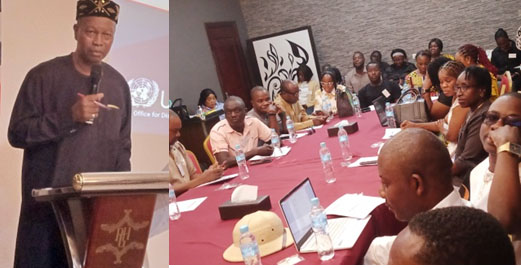
NDMA Exec. Dir. AnsuDulleh& Participants
A three-day international brainstorming session hosted by Liberia through the National Disaster Management Agency (NDMA) and supported by the United Nations Office for Disaster Risk Reduction (UNDRR) commenced on December 16, 2025 at a local hotel in Monrovia.
The gathering which draws participants from inter-sectorial agencies including the Ministries of Transport, Mines and Energy, the Environmental Protection Agency (EPA), the Liberia National Police (LNP), the Liberia National Fire Service (LNFS), and the Liberia Refugee Repatriation and Resettlement Commission (LRRRC), aims at understanding indicators and reporting mechanism of the Sendai Framework, pinpointing gaps in the Sendai Framework reporting, key challenges in disaster data collection and reporting in Liberia, among others.
In his opening address at the workshop which also attracted participants from Nairobi, Kenya, the Executive Director of the National Disaster Management Agency (NDMA), Atty. Ansu Dulleh called on the visiting guests from Kenya to be very meticulous in collecting data that reflect the actual disaster issues in Liberia.
According to him, doing so will not only lend credibility to their findings but also portray the actual disaster prone situations in the country, something the country and her international partners can capture and make meaningful interventions to mitigate the problems.
Mr. Dulleh noted that the workshop came at a crucial moment for Liberia as a climate vulnerable country; climate change is no longer a distinct threat with its on-going disruption of livelihoods, damaging ecosystems, and hampering development process thus affecting women, children, small holder farmers and frontline communities.
“This is why loss and damage sit at the heart of Liberia’s ARREST Agenda, particularly its commitments to resilience, social protection, food security and inclusive growth,” Dulleh opined; stressing that climate shocks threaten to reverse years of hard won progress unless they are address through deliberate prevention, preparedness and fair and accessible climate finance.
Dulleh continued: “The Sandai Framework for Disaster Risk Reduction reminds us that understanding disaster risk is a foundation of resilience as such the DELTA Resilience system provides structure approaches for tackling disaster impacts, losses and damages across sectors over time”.
He noted that by harmonizing methodologies and reporting standards, these systems enable people to translate community level experiences into nationally- owned and international credible evident.
The NDMA head insisted on three priorities to curb disasters saying, “We must invest in national and community level loss and damaged data systems; we must strengthen institutional and local capacities so that data collection, early warning, and reporting are inclusive, consistent, and sustainable; and we must ensure that loss and damage financing is allocated transparently, guided by evidence, equity, and the principle of climate justice.
He told the gathering that by strengthening data systems, it give voice to affected communities, credibility to national claims, and direction to national action, noting, this is how we transform from principle into practice.
Among issues discussed at the workshop include strategies to improve data quality and accessibility; methodological guidance for tracking hazardous events and disaster losses and damages; Data applications and use cases-EW-EA, financing, reporting (SFM, BTRs, GGA, etc.).
The Sendai Framework for Disaster Risk Reduction 2015-2030 outlines seven clear targets and four priorities for action to prevent new and reduce existing disaster risks: (i) Understanding disaster risk; (ii) Strengthening disaster risk governance to manage disaster risk; (iii) Investing in disaster reduction for resilience and; (iv) Enhancing disaster preparedness for effective response, and to “Build Back Better” in recovery, rehabilitation and reconstruction.
It aims to achieve the substantial reduction of disaster risk and losses in lives, livelihoods and health and in the economic, physical, social, cultural and environmental assets of persons, businesses, communities and countries over the next 15 years.
The Framework was adopted at the Third UN World Conference on Disaster Risk Reduction in Sendai, Japan, on March 18, 2015.