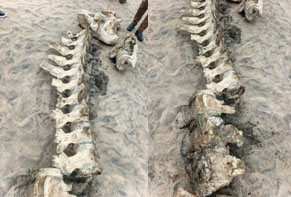
The National Fisheries and Aquaculture Authority (NaFAA) said, it has concluded investigation into the recent stranding of a whale at Sheri Beach, off Congo Town Back Road in Monrovia.
Following the conclusion of the investigation, the Authority has strongly warned public against the “consumption of marine carcasses.”
This means, people should stop eating dead cadavers ashore the Atlantic Ocean near Monrovia.
The investigation, according to a release, was initiated following the circulation of a video on social media showing a marine species being butchered for consumption.
“Upon receiving the report, the Director General of NaFAA immediately dispatched a joint team from the departments of Marine Fisheries, Environment and Climate Change, and Communications and Media Services, to the site to assess the situation,” the release said.
Findings from the investigation, according to the release, confirmed that the stranded marine species was a whale, a protected and endangered species under Liberia’s fisheries laws, and international conservation conventions.
Evidence gathered at the scene suggests that the whale may have died as a result of entanglement in abandoned or discarded fishing nets, commonly referred to as “ghost nets.”
NaFAA emphasized that whales play a vital role in maintaining “healthy marine ecosystems.”
They contribute to nutrient recycling, support marine food chains, and enhance fish productivity.
The protection of whales is therefore essential to biodiversity conservation, sustainable fisheries development, and the long-term health of marine environment.
The Authority has strongly cautioned the public against consuming marine species found dead along the coastline. Marine carcasses may harbor harmful bacteria, toxins, or diseases that pose serious risks to human health. Furthermore, the killing or consumption of protected marine species is illegal and constitutes a violation of national laws and international environmental commitments.
NaFAA also highlighted the growing threat posed by abandoned, lost, or discarded fishing nets.
These ghost nets continue to trap and kill marine life indiscriminately, including whales, sea turtles, and commercially important fish species, long after they are lost at sea.
NaFAA called on all coastal residents, beach caretakers, fishers, and the general public to immediately report any sighting of marine species washed ashore, whether alive or dead, to the relevant authorities. Prompt reporting ensures timely response, safeguards public health, and strengthens marine conservation efforts across the country.