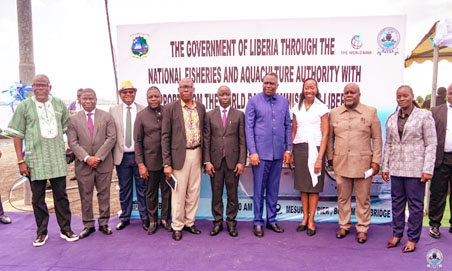
The National Fisheries and Aquaculture Authority (NaFAA), has officially commissioned the Sea King, the nation’s first Semi-Industrial Fiberglass Fishing Vessel that signaled a transformative step in the modernization of the fisheries sector.
The ceremony, held at the Mesurado Pier, also featured the presentation of three of the 23 newly constructed fiberglass Kru and Fanti canoes designed to strengthen artisanal fishing across coastal communities.
NaFAA Acting Director General, J. Cyrus Saygbe, Sr. described the event as “not just a milestone, but a national awakening.”
Saygbe underscored the county renewed commitment to innovation, responsible marine governance, and economic growth. He said the commissioning reflects strong government leadership, deepened development cooperation, and the enduring resilience of coastal populations.
Saygbe highlighted a portfolio of ongoing reforms under government’s ARREST Agenda, including, the development of a 10-Year Strategic Plan (2026–2036), a forthcoming National Fisheries and Aquaculture Investment Plan, and a National Aquaculture Strategy to transition aquaculture to commercial scale.
He also outlined major achievements already underway including, the country first Semi-Industrial Fisheries Management Plan, a strengthened Monitoring, Control and Surveillance (MCS) system; training of over 500 fish farmers nationwide; launch of the National Aquaculture Database System, and National Fishmongers Directory; revitalization of the Fisheries Complex and establishment of a Department of Environment and Climate Change; full activation of the Fisheries Information Management System (FIMS); reducing permit processing time to just 48 hours and progress toward a US$26 million Industrial Fishing Port, expected to create 2,000–2,500 jobs.
Mr. Saygbe further said the ongoing infrastructure investments through the OPEC Fund, World Bank, UN FAO, and Conservation International, including fish processing hubs, landing sites, a fisheries laboratory, and a climate-smart commercial fish farm.
On the fishing vessel, according to Saygbe, “Built using advanced Glass Reinforced Plastic technology, the Sea King promises enhanced durability, safety, efficiency, and sustainability.
It is poised to boost fish production, improve food security, and support responsible harvesting of the country marine resources.”
He said the vessel will be managed through a transparent Public–Private Partnership process.
He disclosed how the 23 fiberglass canoes would reach out to the local fishing communities.
The World Bank Country Manager, Georgia Wallen, described the commissioning of the Sea King Semi-Industrial vessel as a significant advancement toward a modern, investment-ready fisheries sector.
Madam Wallen said the Sea King represents meaningful progress in developing the semi-industrial segment, while maintaining harmony with artisanal fishers’ backbone of coastal livelihoods.