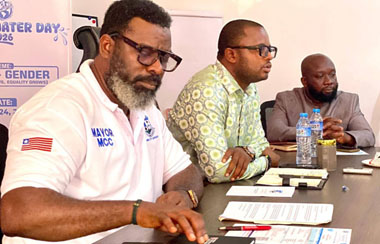
The Mayor of the Monrovia City Corporation, John-Charuk Siafa, has renewed calls for stricter enforcement of new municipal regulations aimed at transforming sanitation and urban management in Liberia capital, warning that Monrovia cannot continue operating under outdated systems while facing mounting environmental and public health challenges.
Speaking Thursday (May 21) at the 5th Sector Coordination Meeting organized by the National WASH Commission, Mayor Siafa defended the newly introduced Administrative Regulations, describing them as a critical tool intended to strengthen sanitation governance improve waste management, and align city operations with national development priorities.
The meeting brought together government officials, donor partners, sanitation stakeholders, and development institutions to discuss the future of water, sanitation and hygiene programs across Liberia amid growing concerns over poor waste disposal, drainage blockage, and environmental degradation in Monrovia.
Mayor Siafa stressed that the new regulations are not designed to replace or undermine Liberia’s existing laws, but rather to enforce them effectively at the municipal level where implementation has often remained weak and inconsistent.
According to him, the regulations are closely aligned with several national and international policy frameworks, including Liberia’s National Open Defecation Free (ODF) and WASH Roadmap
The National WASH Compact, the Public Health Law, the Environmental Protection and Management Law, and the United Nations Sustainable Development Goals, particularly SDG 6 which focuses on clean water and sanitation.
The mayor further argued that the regulations also support the Government of Liberia’s ARREST Agenda for Inclusive Development, which prioritizes infrastructure, sanitation, and improved public services as key pillars for national growth.
As Ambassador for Sanitation, Mayor Siafa maintained that the reforms introduce practical measures intended to directly improve sanitation outcomes in Monrovia, where overflowing garbage, poor drainage systems, and unregulated waste disposal continue to threaten public health and urban development.
He warned that Monrovia’s rapid population growth and urban expansion require more modern and enforceable policies capable of addressing climate-related risks, uncontrolled settlements, and unequal access to essential services.
According to him, the city can no longer rely on outdated administrative structures while residents continue to battle flooding, polluted communities, and inadequate sanitation infrastructure during every rainy season.
He so called for stronger collaboration between the MCC, the WASH Commission, donor agencies, and other government institutions to ensure the successful implementation of public awareness campaigns and behavior change initiatives aimed at improving sanitation practices among residents.
The MCC head emphasized that without coordinated action and stronger public compliance, government efforts to clean the city and improve sanitation standards would continue to face serious setbacks.
During the meeting, the mayor took time to explain several provisions contained in the new Administrative Regulations, triggering a lengthy question-and-answer session among stakeholders seeking clarity on enforcement mechanisms and municipal responsibilities.
Copies of the new regulations were later distributed to participants as city authorities intensified efforts to build wider public and institutional support for the reforms.
For his part, the Executive Director of the National WASH Commission, Morris G. Gino Jr., updated stakeholders and donor partners on ongoing and upcoming projects being pursued by the Commission.
Among the major initiatives highlighted was a pending Memorandum of Understanding with Catholic Relief Services aimed at establishing a centralized data management system for the Commission to improve coordination and monitoring within the sanitation sector.
Mr. Gino praised the growing partnership between the MCC and the WASH Commission, noting that collaboration between institutions remains essential to confronting Monrovia’s worsening waste management crisis.
He also commended Mayor Siafa for what he described as the mayor’s practical commitment to addressing sanitation and waste disposal challenges affecting communities across the city.
Despite repeated sanitation campaigns and millions of dollars invested by international partners over the years, many parts of Monrovia continue to struggle with uncollected garbage, clogged waterways, and limited public sanitation facilities.
Critics have long argued that weak enforcement, poor coordination among government agencies, and lack of public accountability have undermined previous sanitation initiatives in the capital.
The latest push by the MCC and the WASH Commission now places renewed pressure on both authorities and residents to demonstrate whether the new regulations will finally produce visible improvements or become another policy framework with little impact on conditions facing ordinary Liberians.