By Domingo Dargbeh
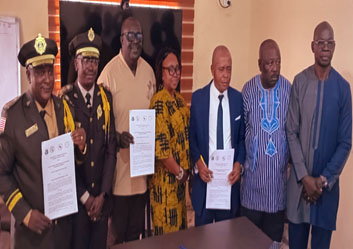
The Liberia Refugee Repatriation and Resettlement Commission (LRRRC), has signed a pivotal Memorandum of Understanding (MoU) with the National Identification Registry (NIR) and the Liberia Immigration Service (LIS).
The MoU is one significant step to enhance the integration of refugees and or returnees.
The signing ceremony, held on Wednesday, February, 25, 2026, in Monrovia, coordinated national effort to implement Executive Orders 144 and 147.
It aims to provide durable solutions for refugees, who have chosen Liberia as their home.
LRRRC Executive Director, Jeror Cole Bangalu, described the ceremony as “historic occasion that symbolizes more than mere administrative cooperation.”
It also reflects Liberia’s enduring commitment to humanitarian protection, regional solidarity, and responsible migration governance.
Bangalu said, the MoU is designed to align with the mandates and technical capacities of the LRRRC, NIR, and LIS, establishing a clear and efficient rights framework for regularizing the legal status of integrated refugees.
This will be achieved through the issuance of biometric resident permits and specialized refugee identification cards, essential for providing secure, verifiable identity documentation. “With proper documentation, our refugee brothers and sisters can fully access essential services, engage productively in national development, and live without the fear of legal uncertainty.”
He added that this initiative is not merely a technical exercise; it is a pathway to dignity, inclusion, and opportunity for refugees.
The LRRRC recognizes that durable solutions cannot be realized in isolation.
He underscored the importance of strong institutional synergy; data system harmonization, and seamless operational coordination.
Through the MoU, the three agencies commit to a unified implementation architecture to ensure timely, transparent, and accountable processes for refugee registration, identity management, immigration regularization, and residency documentation.
The MoU also reinforces Liberia’s compliance with international and regional obligations toward refugees, while advancing national interests in migration management and social cohesion.
“This Agreement sends a powerful message that Liberia remains a country of refuge, compassion and rule of law,” Bangalu said.
He expressed hope that the MoU will stand as a testament to what coordinated governance can achieve in advancing protection, legality, and durable solutions.
Liberia Immigration Service Commissioner, Elijah F. Rufus, reiterated the commitment to the effective reintegration of refugees.
“We are not only identified by our colors; we are also defined by the travel documents we carry,” Rufus told the refugees.
He highlighted the importance of the newly established framework for refugee identification.
“We assure the Liberian people that we are ready to work closely with the LRRRC and NIR to ensure that no eligible refugee is left undocumented and that no opportunity for durable integration is lost.”
This MoU represents a significant milestone in Liberia’s ongoing commitment to support refugees, ensuring their rights, and fostering their successful integration into society.