By Fiona Benson Kollie
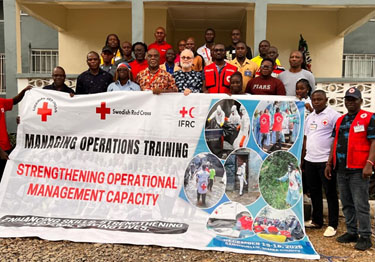
In response to the growing frequency and complexities of humanitarian emergencies in Liberia and the world at large,
The Liberia National Red Cross Society (LNRCS), has launched a five-day Managing Operations Training (MOT).
The training was launched in Sanniquellie, Nimba County, to strengthen the skills of the Red Cross staff and volunteers in managing medium to large-scale emergencies.
The training exercise is one of the steps as Liberia continues to face recurring disasters that include floods, fires, windstorms, erosions, and health emergencies without a well-managed and coordinated local response systems.
The training ran from Saturday, December 13-18. It was held under theme: “Strengthening Operational Management Capacity,” and on the slogan: “Enhancing skills, strengthening systems, saving lives.”
It brought together the MOT, IFRC’s broader Operational Leadership program, and LNRCS National Disaster Response Team (NDRT).
At the training, it was projected that crises can, and will have devastating impacts on affected populations.
To address the challenges, it was upon this back drop, the Global Response Unit of the Swedish Red Cross and the International Federation of Red Cross and Red Crescent Societies (IFRC) are supporting the LNRCS to build stronger local capacity for effective, efficient, and timely emergency response operations management.
And with this, the LNRCS continues to maintain its presence in all 15 counties.
It has also played a pivotal role in responding to some of the most severe emergencies, including Ebola, COVID-19, and widespread flooding and fires.
As part of the operations, the leadership has also earned commendation for effectiveness and resilience.
Base on this, nearly 30 participants, including representatives from the National Disaster Management Agency, the Liberia Meteorological Service at the Ministry of Transport, and the Sierra Leone Red Cross, gathered in Sanniquellie.
“The training is not just about learning new skills, it is about preparing ourselves for the challenges ahead,” said Gregory Blamoh, Secretary General and Chief Executive Officer of the Liberian Red Cross.
Blamoh added that next year will be a challenging year.
He meanwhile, urged all volunteers and staff to work harder, with high professionalism, and deliver better results for the communities they serve.
The Head of the IFRC Freetown Cluster Coordination Delegation, Peter Core Ophoff, underscored the importance of building trust, and strengthening partnerships in disaster response.
This, Ophoff said, is operational management, and not only about logistics and planning, but building trust with communities and ensuring strong coordination with extended partners.
These are the key factors that also determine success in any emergency operation.
“Raising standards in Humanitarian Service Swedish Red Cross Country Representative, Armel Komena highlighted the opportunity for the Liberian Red Cross to demonstrate leadership in the region.
Komena said, by enhancing operational management, the LNRCS can position itself as a hub for peer support, and learning across neighboring national societies.
The MOT is designed as an agile adaptation of international-standard Operational Leadership training, contextualized for Liberia, but with potential for wider application and future standardization.
Organizers expressed the hope the program will initiate a sustained operations management capacity enhancement process for the LNRCS, while also fostering regional collaboration.